
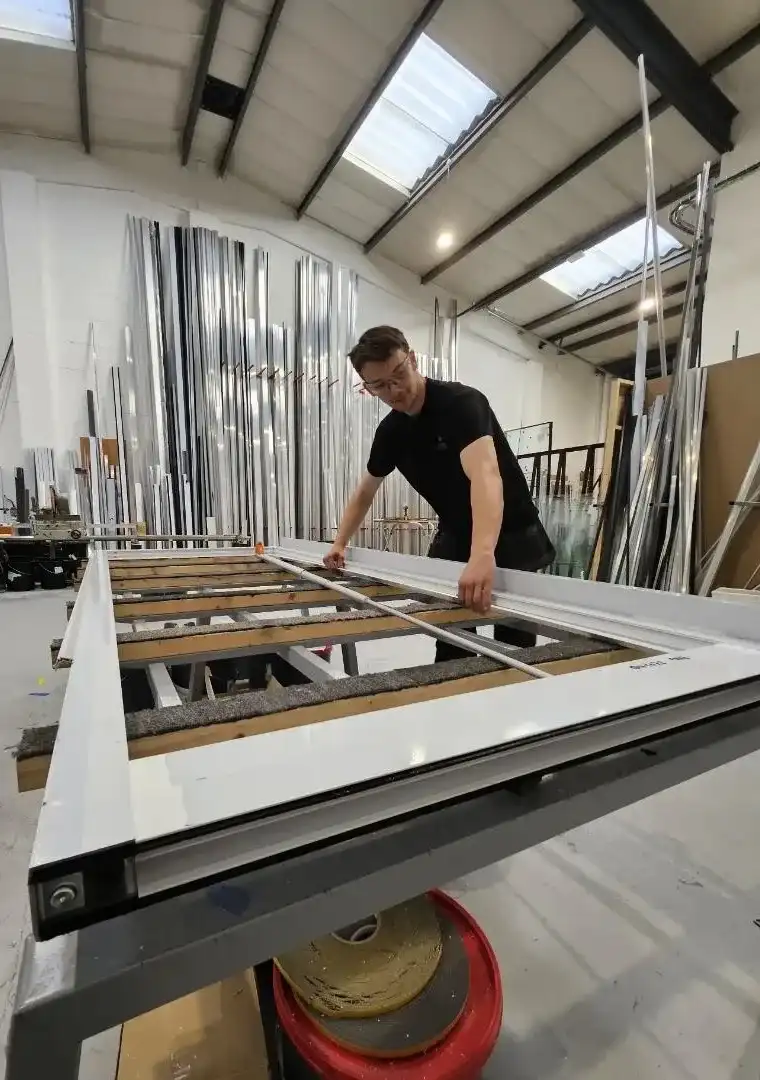
Replacement Commercial Aluminium Doors: Identify the System, Repair or Replace, Measure and Order
Repair a commercial aluminium door when the frame is sound and the fault is hardware — pivots, floor springs, closers, locks or dropped hinges. Replace the leaf, or the full doorset, when the leaf is twisted, the corner joints have worked loose, the profile is obsolete, or repeat call-outs are outpacing the cost of a new leaf fabricated to size. This guide gives maintenance contractors and facilities teams the full workflow: identify the system, make the call, measure and order — from a supply-only fabricator with no stake in the installation.
By Stephen Chappell, Managing Director, Kingsland Fabrications. Updated 3 July 2026. Supply only for trade and commercial customers; we don't install.
Repair or replace: how to decide on the spot
The call comes down to the frame and the corners. If the outer frame is square, firmly fixed and its corner joints are tight, almost any fault you are looking at — a dropped leaf, a dead closer, a jammed lock — is repairable hardware. If the leaf's corner joints have worked loose, the leaf is twisted, or the frame itself is failing, no hardware swap will hold: order a replacement leaf or doorset fabricated to size. Six checks settle it before you leave site:
Frame condition
Is the outer frame square, firmly fixed and free of corrosion at the feet? A sound frame keeps every option open — leaf-only replacement included. A failed frame closes them all: it is a doorset job whatever the leaf looks like.
Corner-joint integrity
Grip the leaf mid-swing and rack it gently. Visible movement along the corner-joint lines means the crimped joints have worked loose. That is structural, not hardware — the leaf is finished, however new the floor spring is.
Leaf twist
Sight down the lock stile with the door closed. A leaf that touches the frame top and bottom but stands off it mid-height is twisted — usually years of slamming against a dead closer. Twist does not adjust out.
Hardware availability
Floor springs, pivots and multipoint locks for current systems are stock items. If the system is obsolete and the exact part is unobtainable, a lasting repair may be impossible at any price — which quietly makes the decision for you.
Thermal-break era
A non-thermal door from the 1980s or 90s in a heated frontage will keep generating condensation and heat-loss complaints no matter how well it swings. If that is what the client is actually complaining about, no repair fixes it — that is a doorset conversation.
Repair history and cumulative cost
Pull the job history for the opening. When the next repair quote is approaching half the cost of a new supply-only leaf, replacement wins on lifecycle cost — the repair keeps the wear and the next failure; the new leaf resets the clock.
One thing worth knowing about who you ask. A repair firm earns from the repair, and an installation company earns from the replacement — both answers arrive with a bias built in. We only supply the metal: your engineers bill their labour whichever way the job goes, and we would rather tell a contractor the honest answer is a new floor spring than sell a doorset that did not need to exist. Contractors who get a straight verdict on the repair jobs come back when the answer is a leaf.
"The doors that cost maintenance contractors money aren't the ones they replace — they're the ones they repair four times first. Track the spend per opening and the decision usually makes itself."
— Stephen Chappell, Managing Director
Why commercial aluminium doors drop — and when it's terminal
A dropped commercial door can result from adjustable hardware, worn components or damage to the leaf and frame. The checks below help separate potentially repairable causes from conditions that may require replacement.
Usually fixable
- Worn bottom pivot or floor spring
- Loose or worn top pivot letting the leaf lean
- Lost toe-and-heel: the glass has slipped in its packers, and re-wedging it restores the leaf's diagonal stiffness
- Failed closer leaving the door to slam itself out of adjustment
Usually terminal
- Crimped corner joints worked loose — the leaf racks into a parallelogram that no packer squares
- Leaf twist from years of slamming against a failed closer
- Corrosion at the threshold, in the bottom rail or at the frame feet
- Obsolete profile with unobtainable hardware — repairable in theory, not in practice
The reason a racked leaf is terminal is how commercial aluminium doors are built. UK commercial aluminium is mechanically joined — crimped corners and cleats, not welds — so once a corner joint has worked loose there is nothing to dress straight or re-weld. The joint held the leaf square; with it gone, the leaf is done. Ten minutes on site tells you which list you are on: check the gap pattern around the leaf (tight at the top leading edge and wide at the bottom points at the pivot; an even gap with the leaf out of plane points at twist), lift the leading edge by hand to feel for pivot movement, rack the leaf gently to test the corners, then check whether the glass has slipped in its packers. Photograph what you find as you go — the same photos drive the quote later. The hardware and operation section of our glossary covers the terms if the client wants the finding in writing.
How to identify which aluminium door system you're looking at
Every replacement enquiry starts with the same question: what system is this? Two measurements and three useful photos provide a practical first identification pack, although further details may still be needed. Measure the frame depth (front to back across the jamb) and the stile width (a tape laid across the lock stile), then photograph the full elevation, the stile with the tape in shot, and the pivot or hinge detail. Frame depth narrows the candidates; bead style, pivot arrangement, sightlines and any visible markings help confirm the route.
We fabricate Jack Aluminium systems day to day, but replacement work means recognising everyone else's, because the door in front of your engineer could be from any systems house of the last forty years. These are the ones that come up most:
| System | Systems house | Where you'll meet it | First checks |
|---|---|---|---|
| JD47 | Jack Aluminium | Retail shopfronts, high streets, shopping centres | Non-thermal, 47mm frame depth, 50mm sightlines; 6–28mm glazing; typically floor-spring hung with integral external beading |
| TD68 | Jack Aluminium | Offices, schools, public and healthcare buildings | Thermally broken, 68mm frame depth; 24–44mm glazing; heavy leaves on pivots rated to 250kg; anti-finger-trap stiles |
| 190 series | Kawneer | Decades of retail and office stock | Long-serving heavy-duty entrance door with several stile widths — measure the stile rather than assume; often sits in Kawneer framing |
| GT55 | AluK | Shopfronts, education and commercial entrances | Commercial swing-door family with a nominal 55mm depth — a mid-50s frame-depth reading is the first pointer |
| SPW501 | Senior Architectural Systems | Education and healthcare projects | Check for Senior framing and windows on the same elevation — systems tend to travel together across a building |
| Smart Systems (various) | Smart Architectural Aluminium | Broad commercial door and shopfront use | Widely fabricated, so visual tells vary — the stile photo and depth measurement do the identifying |
| Comar (e.g. 7P.i) | Comar Architectural Aluminium Systems | Office and public-sector stock, usually within Comar screens | Look at the surrounding framing profile — the door is usually part of a wider Comar elevation |
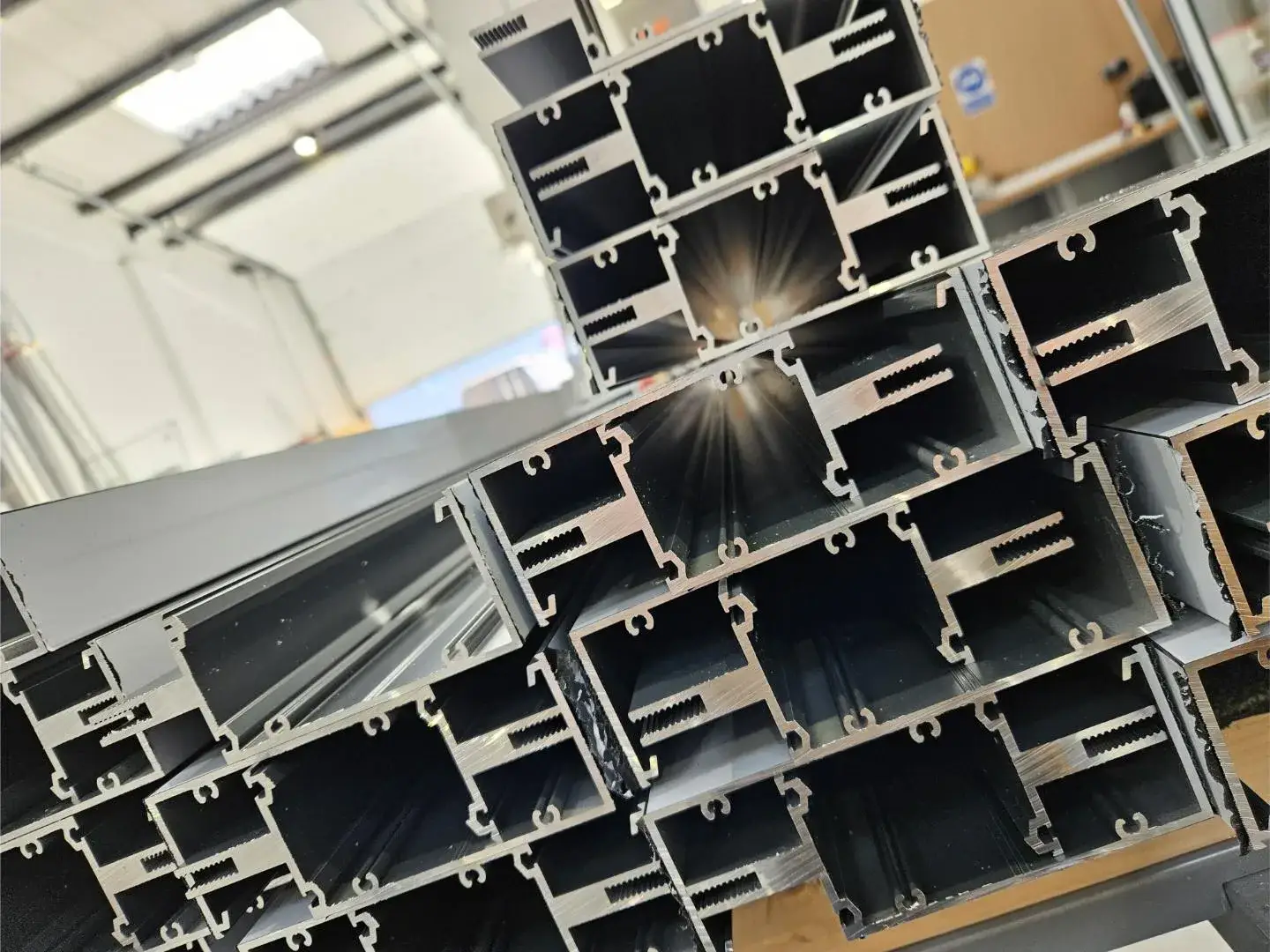
If the system turns out to be discontinued, the job is still on. A matching leaf can usually be fabricated in a current compatible profile with the same sightlines and hardware preps, powder-coated to the existing RAL. Where nothing current will marry to the old frame — different rebates, different thermal era — the honest answer is a new doorset, and we will say so rather than force a leaf that half-fits.
The practical shortcut
Send us three photos — the full door, a stile close-up with a tape across it, and the pivot or hinge detail — plus two measurements: stile width and leaf thickness. We will review the system information and talk through the available options.
Send them over WhatsApp or call 01925 500 295 from site.
Can you order just a replacement leaf, or do you need the whole doorset?
A replacement leaf can be supplied on its own when three conditions hold.
Leaf-only works when:
- The system — or a compatible current profile — is still in production, so the new leaf marries to the old frame's rebates and seals.
- The frame is square, sound and firmly fixed — a new leaf hung in a failing frame inherits every one of its problems.
- The lock, pivot and closer positions have been surveyed and compatibility confirmed, so the replacement can be prepared to the approved detail. The installer remains responsible for the site fitting plan and commissioning.
Order the full doorset when: the frame's own corner joints have failed; the thermal-break eras mismatch — hanging a thermally broken leaf in a non-broken frame solves nothing, because the frame keeps conducting the heat and growing the condensation; or the threshold needs rebuilding for level access, which is a frame job by definition — our thresholds and level-access guide covers that decision in detail.
Colour matching: a fresh RAL 7016 leaf hung against powder coat that has weathered for fifteen years may read differently. The options are to match to an agreed sample, have the surrounding framework resprayed on site by a specialist, or accept an agreed variance. Record the chosen route before the order.
How to measure for a replacement commercial aluminium door
Six steps, one site visit. This is exactly what we need to quote and fabricate — nothing here is optional padding. For a printable version, use our replacement survey checklist.
Confirm leaf-only or full doorset
Check the outer frame first: square, firmly fixed, corner joints tight means a leaf-only order. A failed frame, a thermal-break mismatch or a threshold rebuild means measuring for a complete doorset instead.
Measure the opening at three points
Leaf-only: rebate-to-rebate width and height, each taken at three points — work to the smallest. Full doorset: the structural opening brick-to-brick, again at three points, again to the smallest.
Record the leaf dimensions
Leaf thickness and stile width, taken with a tape laid across the lock stile. These two numbers do most of the system identification as well as the sizing.
Map the hardware
Lock height and backset, pivot centres and spindle position, and the closer or floor-spring make and model if a badge is visible. Preps we can replicate exactly are what make the swap a one-visit job.
Check the threshold and floor levels
Note the threshold condition and the finished floor levels both sides. If the entrance is on an accessible route, flag it — Approved Document M expects level access with a maximum 15mm threshold upstand.
Photograph and send
Full elevation, stile close-up with the tape in shot, and the pivot or hinge detail. Send the photos with the sizes, specification, delivery postcode and required date so the quote reflects the actual order.
Ordering: lead times, colour and first fit
Allow approximately 21 working days for general planning. The quotation confirms the current lead time, its start point, the exact date and any product-, finish-, glass- or hardware-specific exceptions. Sizes at three points, useful photos, the hardware specification and the RAL number help us price the correct product without avoidable follow-up questions.
What arrives on the pallet is the finished job: the leaf or doorset fabricated to your sizes on TD68 or JD47 profiles as the specification demands, hardware fitted or prepared to your positions, glazed and beaded where specified, labelled by opening reference, delivered from our Warrington workshop throughout mainland Britain. Every swing door is assembled and function-checked on the workshop jig before dispatch as fabrication QC, not standards or certification testing.
Kingsland supplies made-to-order replacement fabrication; we do not provide emergency repair or make-safe work. If the entrance cannot be secured, arrange that separately while the permanent replacement is fabricated.
Frequently asked questions
Can a dropped commercial aluminium door always be repaired?
Usually, if the cause is hardware: a worn floor spring, bottom pivot or lost toe-and-heel wedging can all be corrected. It cannot be economically repaired when the leaf's crimped corner joints have worked loose or the leaf is twisted — no amount of packing squares a racked leaf, and that is when you order a replacement fabricated to size.
How much does a replacement commercial aluminium door leaf cost?
There is no honest flat rate — the price of a leaf fabricated to size is driven by its dimensions, the glazing specification, the hardware preps that need replicating and the finish, and a complete doorset always costs more than a leaf alone. Send sizes, hardware detail and useful photos so we can prepare a supply-only quotation.
What is the lead time for a replacement commercial aluminium door?
Allow approximately 21 working days for general planning. The quotation confirms the current lead time, its start point, the exact date and any product-, finish-, glass- or hardware-specific exceptions. Kingsland fabricates the permanent replacement after the site team has secured and surveyed the opening.
What if the door system is discontinued?
A matching leaf can usually be fabricated in a current compatible profile with the same sightlines and preps, colour-matched by RAL powder coating. If the old frame itself is failing, a new doorset in a current system is the honest recommendation — retrofitting into a failed frame just books the next call-out.
Do replacement commercial doors have to meet Part L or Part M?
A like-for-like leaf swap into an existing frame is generally treated as a repair. Replacing the complete doorset is a controlled fitting, so the new doorset needs to meet the thermal requirements of Approved Document L — in practice a thermally broken system — and entrances on accessible routes should provide level access with a maximum 15mm threshold upstand under Approved Document M. We flag both at quote stage.
What do you need from me to quote a replacement door?
Three useful photos (full elevation, stile close-up with a tape across it, pivot or hinge detail), leaf or opening sizes measured at three points, hardware specification and colour. We will review the system, talk through leaf-only versus complete doorset and prepare a quotation with a CAD drawing where required.
Keep reading
Replacement Fabrication
How replacement supply works end to end — survey in, fabricated leaf or doorset out, for maintenance contractors and facilities teams.
Replacement Survey Checklist
The printable measure sheet behind the six steps above — everything a fabricator needs from one site visit.
TD68 Commercial Aluminium Doors
The thermally broken system most doorset replacements land on — 68mm profiles, 250kg pivot capacity, PAS 24 tested.
Door Thresholds & Level Access
When a replacement triggers the level-access question — threshold options, Approved Document M expectations, and how to spec them.
Ordering a replacement door? Call 01925 500 295 or use the quotation form — send your sizes and specification, adding photos where they help explain the existing door. We will review the scope and prepare a quotation.