
Make-Safe to Replacement: Commercial Door Call-Out Triage
A field checklist for maintenance teams deciding whether a failed commercial aluminium door can be made safe, repaired, or needs a fabricated replacement.
By Stephen Chappell. Published . Updated .
Reactive door calls are easy to waste. The engineer arrives, frees the leaf, oils a closer, takes two photos, and the job goes back into the queue as “monitor”. Two weeks later the same entrance drops again and the end client asks why the first visit did not solve it.
The better approach is to make one visit do three jobs:
- Make the entrance safe for the client and the public.
- Decide whether the fault is repairable hardware or a failed aluminium assembly.
- Capture enough evidence for a proper replacement quote if the door is past repair.
This checklist is written for maintenance managers, door engineers and fitters working on commercial aluminium entrances. It is not a legal compliance document. It is a practical field workflow for avoiding repeat visits and bad replacement orders.
The 10-minute triage
Start with the opening, not the hardware. A commercial aluminium door can have a failed lock, closer or pivot and still be a repair. It becomes a replacement problem when the aluminium leaf, outer frame, threshold or fixing condition has failed.
Use this sequence before touching the adjustment screws.
1. Can the entrance be used safely now?
Look at public access first:
- Is any glass cracked, loose or unsupported?
- Is the leaf dragging badly enough to trip, jam, or swing unpredictably?
- Can the entrance still be locked or secured out of hours?
- Is the route part of an escape path?
- Would any temporary board, barrier or padlock block an escape route or an accessible entrance?
If there is doubt, make the opening safe before surveying it. For work at height, follow the site risk assessment and HSE guidance for ladders and stepladders. Do not create a second incident while trying to close the first ticket.
2. Is the outer frame still doing its job?
Open the leaf and check the frame before blaming the closer.
Capture these points:
- Jambs plumb, or visibly leaning.
- Head level, or sagging.
- Fixings tight, loose, corroded or missing.
- Frame feet damaged by water, impact or cleaning chemicals.
- Threshold fixed and supported, or rocking under foot.
- Diagonals reasonably consistent, or the frame clearly racked.
If the frame is loose or out of square, fitting a new lock or pivot is usually just buying time. A replacement leaf hung in a failed frame is also a poor bet. This is where the job moves toward a full doorset or shopfront section.
3. Is the leaf structurally sound?
A dropped door is often hardware. A twisted leaf is not.
Check the leaf itself:
- Sight down the lock stile with the door closed.
- Watch the top and bottom gaps as the door swings.
- Grip the leaf and feel for movement across the corner joints.
- Check whether glass packers have slipped and removed diagonal stiffness.
- Look for impact marks at the bottom rail, meeting stile and threshold.
If the leaf is square and the frame is sound, keep investigating hardware. If the leaf is twisted or the crimped corners move, quote a fabricated replacement leaf or doorset.
Repair, replace leaf, or replace doorset?
Use this split.
Repair is usually sensible when:
- The frame is square and fixed.
- The leaf is square.
- The issue is a floor spring, pivot, closer, lock, keep, cylinder or packing.
- Hardware parts are available.
- The threshold and access detail are unchanged.
A replacement leaf is usually sensible when:
- The outer frame is sound.
- The existing leaf is twisted, badly worn or impact damaged.
- The hardware positions can be surveyed accurately.
- The client wants a quick swap without opening up the surrounding frontage.
A full doorset is usually sensible when:
- The frame is loose, corroded, racked or poorly fixed.
- The threshold needs changing.
- The job triggers a wider access, weathering or thermal performance decision.
- The existing system is obsolete and the frame cannot sensibly receive a new leaf.
If the opening is on an accessible route, treat the threshold and finished floor levels as part of the decision, not an afterthought. Approved Document M is the reference point for accessible entrance thinking in England, and a door that technically fits but creates a trip or access problem is not a successful replacement.
The make-safe record
Every make-safe visit should leave a short record that the maintenance desk can use later. A useful record is specific enough that another engineer can understand the state of the opening without calling the first engineer.
Capture:
- Job address, asset reference and opening reference.
- Date, time and who attended.
- Reason for call-out in the client’s words.
- What was unsafe or unusable.
- Temporary action taken.
- Whether the door remains in service, restricted service, or out of use.
- Whether an escape route or accessible route is affected.
- Photos before and after.
Do not write “door repaired” if the action was only temporary. Use plain wording: “made safe, replacement recommended” or “adjusted, monitor, quote if fault returns”.
The replacement quote pack
When the door needs replacing, the best thing your engineer can do is send a complete pack while still on site. That is what turns a reactive ticket from a vague enquiry into a fabricator-ready quote.
Send these minimum photos:
- Full elevation from inside and outside.
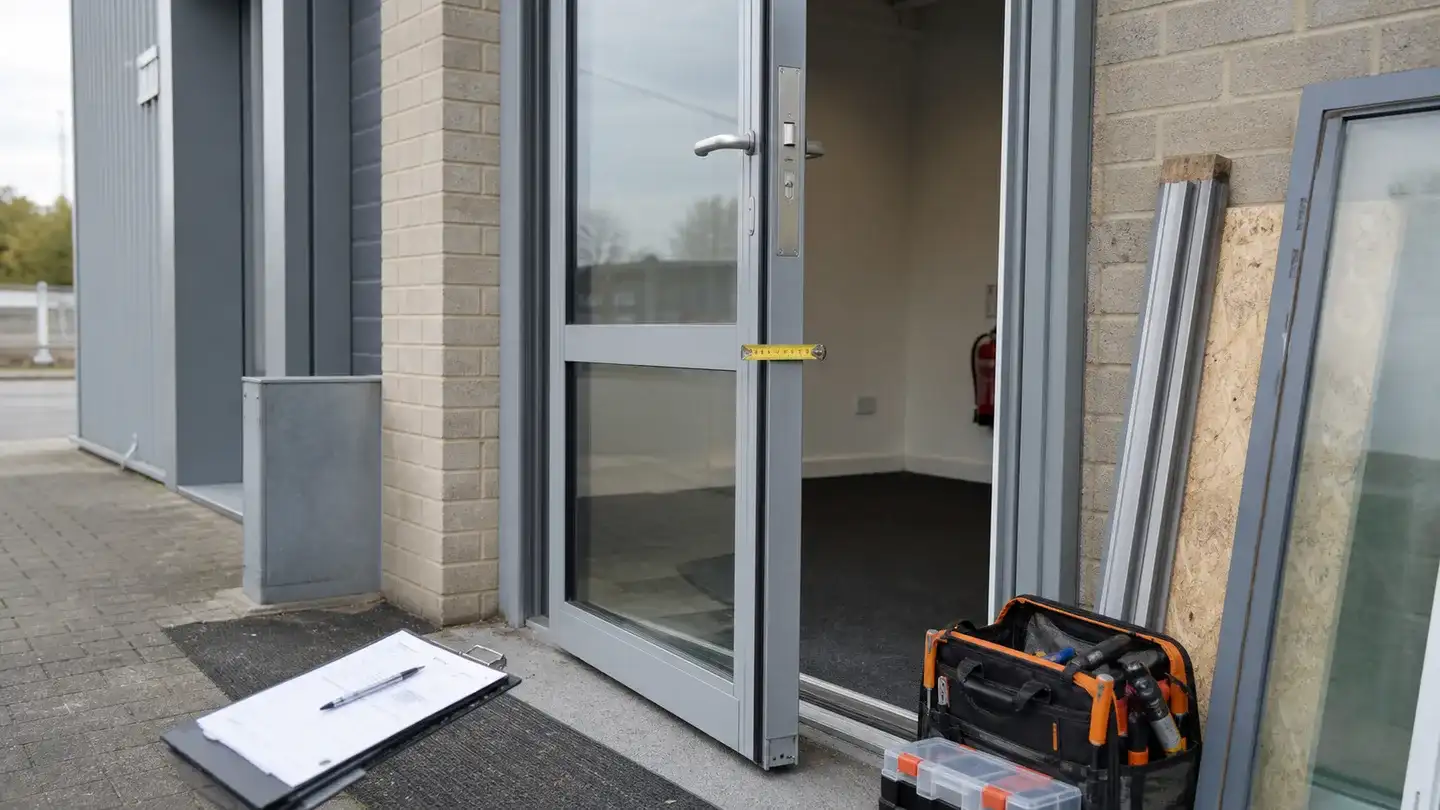
- Lock stile with a tape across the profile.
- Hinge, pivot or floor-spring area.
- Threshold and floor levels both sides.
- Lock, keep, panic hardware, access control and closer.
- Any damage, distortion or water ingress.
Send these minimum measurements:
- Structural opening width at top, middle and bottom.
- Structural opening height at left, middle and right.
- Existing leaf width and height if leaf-only is being considered.
- Stile width, rail depth and leaf thickness.
- Lock height, spindle height, backset and keep position.
- Threshold height and available floor build-up.
- Swing direction and handing.
Add the commercial information:
- Required-by date.
- Whether the building is trading.
- Whether the existing entrance is boarded, locked or still in use.
- Colour, or whether RAL match is needed.
- Glazing type if known.
- Any client constraint on access control, panic hardware or operator interfaces.
That pack lets a fabricator issue a sensible supply-only quote and drawing without a chain of follow-up questions. It also protects the maintenance company: if the end client later asks why replacement was recommended, the record is already there.
What not to promise on site
Avoid these promises until the survey has been checked:
- “We can reuse all existing hardware.”
- “A new leaf will fit the old frame.”
- “The threshold can stay exactly as it is.”
- “This will be like-for-like with no compliance implications.”
- “The colour will match perfectly.”
- “It will be ready by Friday.”
On reactive jobs, the honest answer is often “we can make it safe today, then quote properly from the evidence”. That is better than committing the fabricator to a date or spec the survey does not support.
When to call before leaving site
Call the fabricator while the engineer is still there if any of these apply:
- The system is unknown and the profile is unusual.
- The client needs a leaf-only replacement and the frame condition is borderline.
- The entrance includes panic hardware, access control or an automatic operator.
- The threshold has an access issue or water-ingress complaint.
- The shop cannot trade securely.
- The opening is too distorted to measure confidently.
The engineer is already next to the door. A two-minute call can save a second visit.
Where this fits with supply-only fabrication
On a supply-only order, the installer or maintenance company owns the survey. The fabricator owns the accuracy of what it makes to that survey. That split only works when the survey pack is good.
For door replacements, start with the broader replacement commercial aluminium doors guide and the downloadable replacement survey checklist. The aluminium fabrication lead-times guide explains the product-specific working-day allowances and what can move the quoted date.
If you want us to review a replacement opening, send the photos, sizes and required-by date through the trade quotation form. We will tell you whether a leaf-only replacement or a full doorset is suitable before anyone cuts metal.