
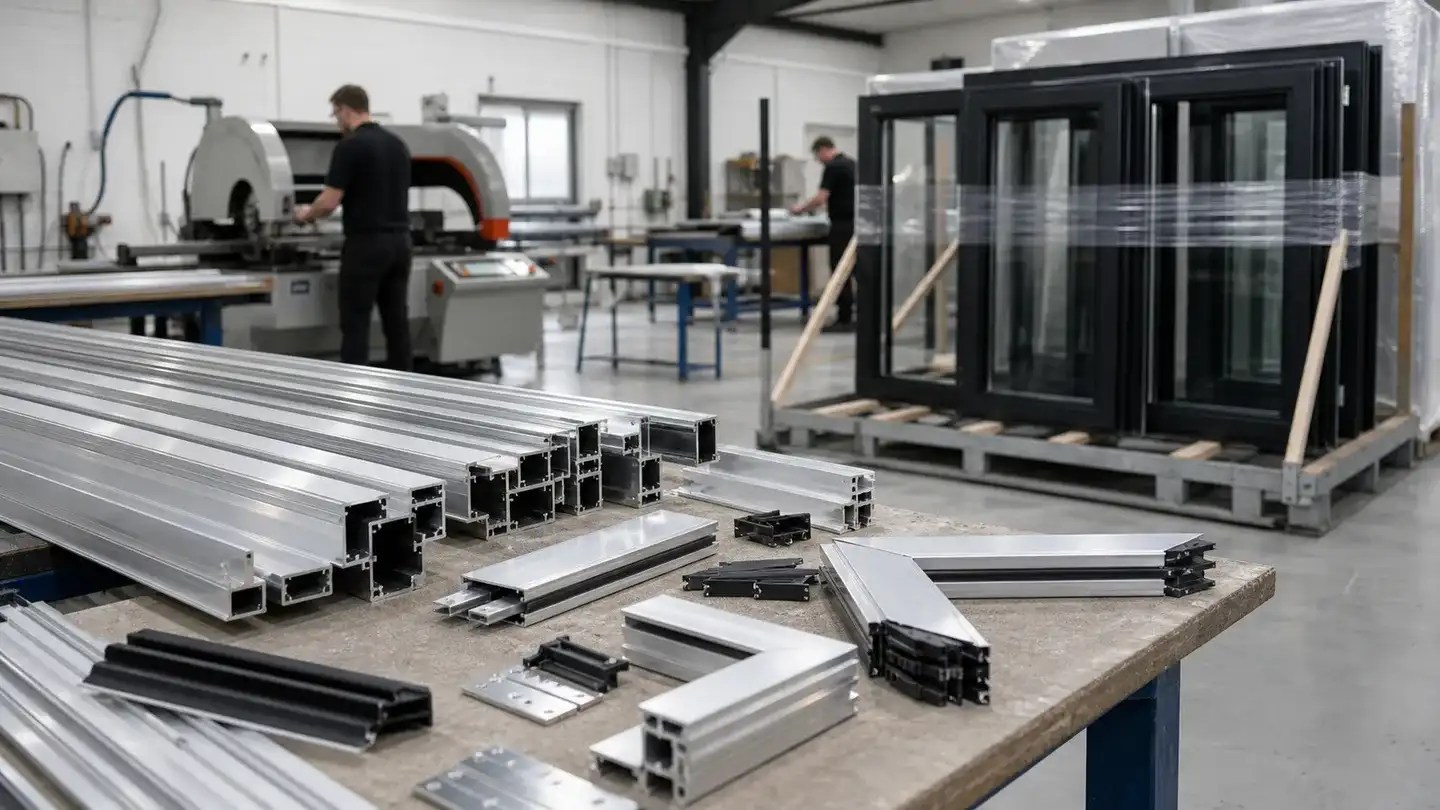
Fabricate Aluminium Shopfronts In-House, or Buy Supply-Only?
The answer depends on your year-round volume, product mix and fully loaded workshop cost. This guide sets out the machinery, premises, labour, software, stock, compliance and scrap lines to compare with current supply-only quotations using your own figures.
By Stephen Chappell, Managing Director, Kingsland Fabrications. Updated 3 July 2026. Supply only for trade and commercial customers; we don't install.
The short answer: it comes down to sustained volume
There is no universally cheaper option. An in-house calculation must divide machinery, premises, labour, software, training, compliance, stock, finance and scrap across the frames you can actually produce. Compare that result with current supply-only quotations for the same product mix and specification.
A declaration of interest: Kingsland Fabrications is a supply-only fabricator, so we earn when a trade or commercial customer buys frames from us. Treat this page as a list of cost lines to test, not a substitute for machinery, employment, systems-house and supply-only quotations.
The comparison further down shows how each cost line can behave at illustrative annual volumes. Replace those descriptions with your own quotations, measured output and realistic utilisation assumptions before making the decision. The rest of this page is written from a supply-only fabricator's own workshop floor.
What machinery do you need to fabricate aluminium shopfronts?
A shopfront fabrication plan needs to account for these six equipment groups before the first frame is assembled. UK commercial aluminium is mechanically joined — cut, machined, cleated or crimped rather than welded — so the exact setup depends on the selected system:
Double-mitre saw
The workhorse: it cuts both mitred ends of a bar to length and angle in one setup, and everything downstream depends on its accuracy. New machines from the established brands are a serious capital purchase on their own.
Corner crimping press
UK commercial aluminium frames are joined over internal cleats, with the profile crimped mechanically around them — not welded. The crimper turns four cut bars into a rigid, square corner; there is no shopfront line without one.
Copy router or CNC machining centre
Lock cases, hinge preps, spindle holes and drainage slots all need the correct machining route. A copy router is a manual option; a CNC machining centre automates repeatable preparation from the approved data.
End miller
Prepares transom and mullion ends so T-joints sit correctly against the mating profile. Include the tooling and system-specific setup in the machinery plan.
Assembly benches and jigs
A frame can be in tolerance on every cut and still rack out of square during assembly. Benches, jigs and a documented checking process are therefore part of the production setup, not optional storage space.
Extraction, air and handling
Plan the swarf extraction, compressed air, racking and handling equipment required by the chosen machinery and profile lengths. Confirm the workshop, power and safety requirements with the equipment suppliers.
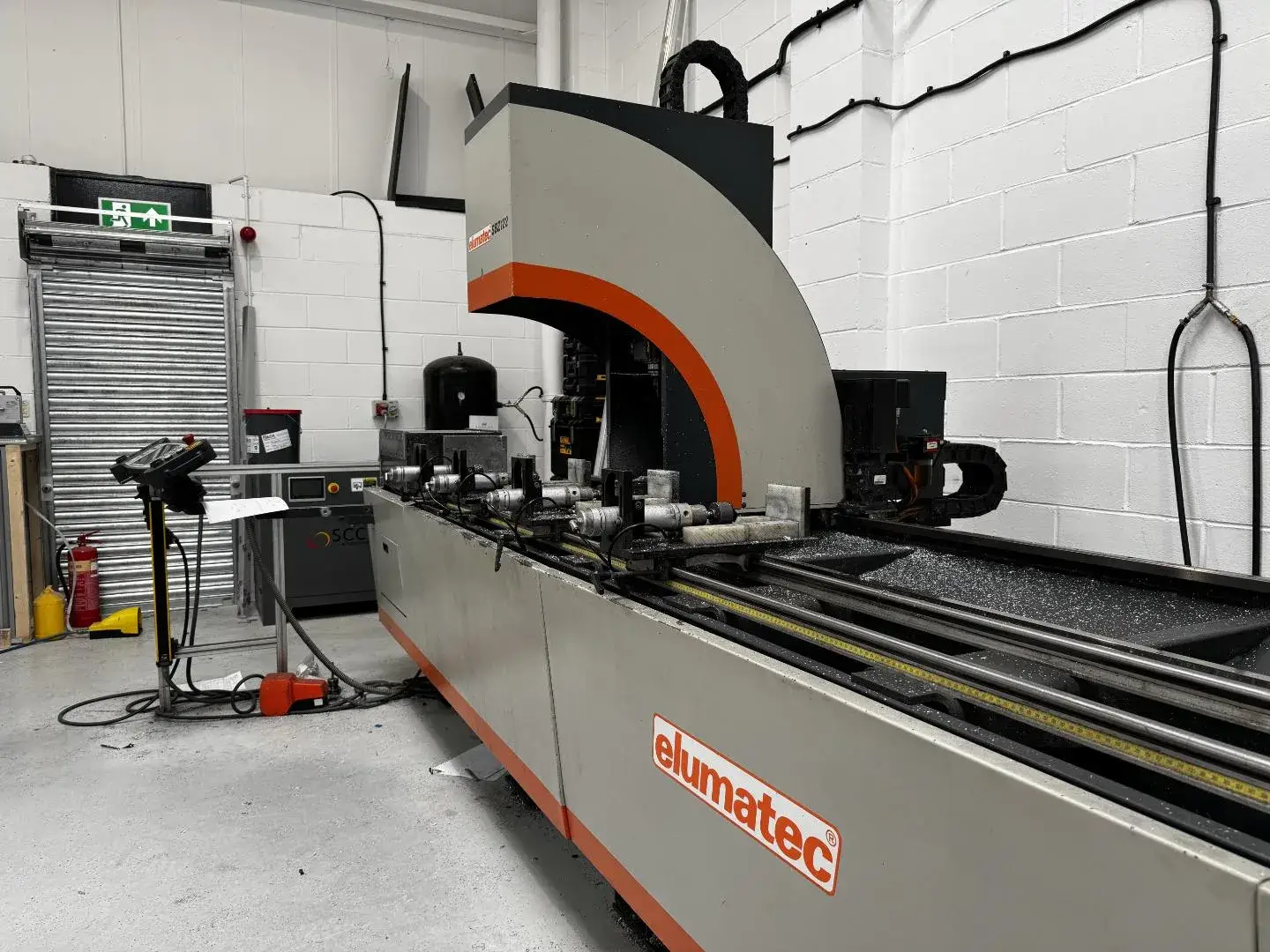
Machinery suppliers you may encounter include Elumatec and Haffner. Kingsland runs Elumatec CNC machinery engineered from LogiKal, so the equipment categories here reflect our own production process; another system or product mix may need a different setup.
Second-hand machinery takes real money off the outlay, but calibration, tooling and support risk transfers to you. A saw cutting half a degree out doesn't announce itself — it shows up weeks later as frames that won't sit square.
Used machinery can reduce the purchase price, but the full investment also includes tooling, installation, calibration, power, extraction, software, training and support. Fabricating doorsets may add testing, conformity and factory-production-control requirements that the machinery list alone does not show.
Cost lines to include beyond the machinery
A machine quotation is only one part of the budget. Include these six cost lines in the same comparison.
- Premises. A fabrication line needs real floor area — machines, benches and racking for profile bars over six metres long — plus 3-phase power. Profile storage eats workshop space before you cut anything.
- Labour. Model the full employment cost, training time, productive hours, holiday and absence cover. A one-person line also needs a continuity plan.
- A systems-house fabricator account. Jack Aluminium is the systems house whose profiles Kingsland fabricates; Smart Systems and Senior Architectural Systems are other routes a buyer may assess. Confirm each provider's current account, training, software and purchasing terms directly.
- Powder coating logistics. Buy mill-finish and every order adds a trip to the powder coater — transport, queue time and batch charges. Hold coated stock instead and working capital sits on a rack in colours a future order may never call for.
- Scrap and remakes. Include a realistic allowance for setup pieces, mis-cuts, damaged finishes and remakes. Test more than one allowance in the cost model rather than assuming mature production from the first order.
- Certification, if you make doorsets. Depending on the product and route to market, testing, conformity marking, factory production control and audits may add setup and recurring costs. Establish the applicable requirements for the exact doorset before investing.
The compliance terms above are unpacked in the performance standards section of our glossary.
Worked example: cost per frame, in-house vs supply-only
Current machinery, employment, energy, finance and material prices must come from your own quotations. The comparison structure is to divide the relevant fixed costs across a realistic annual frame count, add variable materials, labour and scrap, then compare the result with a supply-only quotation for the same work. The table shows questions to test at roughly 100, 250 and 500 frames a year; it is not a published break-even point.
| Cost line | ~2 frames a week | ~5 frames a week | ~10 frames a week |
|---|---|---|---|
| Machinery and premises amortisation | Dominant — the whole line carried by roughly 100 frames a year | Falling, but still a visible slice of every frame | Thin per frame across roughly 500 frames a year |
| Fabricator labour | A full-time wage for a part-time workload — idle hours land on every frame | Better utilised; holidays and sickness still stop the line | Fully utilised — and probably needs a second pair of hands |
| Profile, glass and hardware buying | Test supplier terms, minimum quantities, delivery charges and stock holding | Recheck terms against the actual mix of profiles, glass and hardware | Ask suppliers for current terms; include the cost and risk of held stock |
| Scrap and remakes | A small number of remakes can materially change the unit calculation | Use measured production data once it exists, not an assumed improvement | Apply the measured rate to the actual product mix and complexity |
| Decision test | Compare the fully loaded unit cost with current supply-only quotations | Stress-test volume, utilisation, staffing, scrap and finance assumptions | Confirm that projected volume and product mix hold across the whole year |
To rerun it with your own numbers you need five inputs: your real frame count over the last twelve months (not your best month annualised); the fully loaded machinery cost including tooling and training; a fabricator's total employment cost; a realistic first-year scrap allowance; and real supply-only trade prices from quotations.
We can supply that last input directly: send a typical job spec through our trade quotation form and we will prepare a supply-only price, with CAD drawings where required, to plug into your comparison.
When in-house fabrication may suit the business
These conditions can strengthen an in-house business case, subject to the actual cost, capacity and compliance figures:
Sustained volume with your own pipeline
Sustained year-round demand lets machinery, premises and labour be divided across more output. The calculation still needs to include finance, stock, scrap, compliance and downtime.
Product-mix control
If your work leans on unusual preps, non-standard details or single-item specials, owning the workshop shortens the route between your surveyor and the production data.
Direct control of remakes
An in-house team controls when a remake enters its own queue, subject to having the right profile, finish, hardware and staff available. That control can matter to firms with consistent replacement volume.
Strategic independence
An in-house line replaces an external supplier lead time with your own material, labour, coating and production constraints. Some firms may value that direct control even when the unit-cost comparison is close.
A firm may also assess a phased approach: define a tightly controlled internal-screen scope and keep buying doorsets from an approved supplier while it builds people, equipment and process capability. The technical, conformity and insurance requirements still need checking for every product included in that scope.
One practical hybrid model
One option is to keep surveying and installation with the customer's team while outsourcing fabrication to a supply-only workshop. Supply-only trade fabrication exists precisely for that split.
Risk allocation belongs in the comparison. Under supply-only, the fabricator is responsible for the approved fabrication scope. Every Kingsland swing door is assembled and function-checked on the workshop jig before dispatch as fabrication QC, not standards or certification testing, while wider orders are checked against the approved information. For an in-house line, record scrap, remake and lost-production costs rather than assuming them away.
Lead time works the same way. Allow approximately 21 working days for general planning. The quotation confirms the current lead time, its start point, the exact date and any product- or specification-specific exceptions, and orders are delivered palletised from Warrington throughout mainland Britain. An in-house queue is only as resilient as its people and material supply.
"The installers who get this decision right count a full year's real volume, not their best month. A saw only earns its keep in the weeks it's cutting — and your fabricator takes holidays even when your order book doesn't."
— Stephen Chappell, Managing Director
In-house vs supply-only at a glance
| Factor | In-house fabrication | Supply-only fabricated |
|---|---|---|
| Up-front capital | Heavy — machinery, premises, software, profile stock | Workshop capital sits with the supplier; you pay under the quoted order terms |
| Cost per frame at low volume | High — fixed overhead concentrates on few frames | Use a current quotation for the same product and specification |
| Cost per frame at high sustained volume | Model against measured utilisation, labour, stock, scrap and finance costs | Request current terms for the actual volume, mix and staging requirement |
| Lead time control | Yours — subject to your own material, labour and coating capacity | The fabricator's — allow approximately 21 working days for general planning; the quotation confirms current timing, its start point, the exact date and exceptions |
| Certification burden (doorsets) | Yours — PAS 24 testing, UKCA marking, factory production control audits | Carried by the fabricator |
| Quality and tolerance risk | Yours — the learning curve is paid in remakes | The supplier is responsible for the approved fabrication scope; every Kingsland swing door is assembled and function-checked on the workshop jig before dispatch as fabrication QC |
| Scalability | Hire another fabricator, buy more equipment | Supplier capacity, staging and date are agreed through the quotation |
| Cash flow | Capital tied up in machinery and bar stock | Payments follow the agreed order terms without owning the fabrication line |
The five-question checklist
- Weekly volume that holds across the whole year — count last year's actual frames, not the best month annualised.
- Your own installation pipeline to absorb the output, without chasing work to keep the saw busy.
- Capital that isn't better spent on surveyors, vans or winning more installation work.
- A local hiring market where skilled aluminium fabricators can actually be found.
- Appetite for compliance admin — PAS 24, UKCA and factory production control if doorsets are on the list.
Use the answers to build a costed business case, then compare it with current supply-only quotations for the same product mix. Sensitivity-test lower volume, absence cover, material delays and a higher scrap rate before committing capital.
Frequently asked questions
How much does it cost to set up in-house aluminium fabrication in the UK?
There is no single figure. Build a current quotation for the machinery, tooling, extraction, compressed air, handling equipment, premises, power, labour, software, training, certification and profile stock your chosen systems require. Compare that fully loaded cost with real supply-only quotations before deciding.
What volume of work justifies fabricating in-house?
There is no universal threshold. Divide machinery amortisation, premises, a fabricator's full employment cost, software, certification and a realistic scrap allowance across your true annual frame count, then compare the result with current supply-only quotations. Test the calculation at lower and higher volumes rather than relying on one projected month.
Can installers buy aluminium profile directly from the systems houses?
Profile-buying arrangements and account terms vary by systems house. Ask the named systems provider what fabricator onboarding, training, software, order quantities and stock arrangements apply before building a business case around direct profile purchasing.
Can I buy cut-to-assemble sets and assemble the frames myself?
Some fabricators supply knock-down packs, but the squareness risk transfers to you: a cut set can be in tolerance on every cut and still rack out of square when assembled without a jig. If you don't run a jig table, buy frames assembled and checked square.
What does 'supply-only fabricated' actually include?
For a Kingsland order, the quotation and approved detail state what is cut, machined, joined, glazed, supplied loose and included with the frame. Orders are checked against the approved information; swing doors are assembled and function-checked on the workshop jig as fabrication QC, not standards or certification testing. CAD is provided where required, items are labelled by opening reference and the order is prepared for collection or palletised delivery as quoted. Your team or appointed contractor installs.
Keep reading
Supply-Only Trade Fabrication
What supply-only means in practice, where our work ends and your fit begins, and why it keeps your margin clean.
Aluminium Shopfront Systems
The JD47 + JCW frontages we fabricate — frames, display zones, signage zones and entrance doors as one set.
Trade Aluminium Fabrication
How we work as a made-to-order trade fabricator for installers, contractors and glaziers.
Curtain Walling Cost Guide
The same cost-testing approach applied to curtain walling — the anatomy, the variables and what moves a quote.
Weighing it up? Call 01925 500 295 or use the quotation form. Send a representative order size and specification and we will prepare a supply-only quotation to use in your comparison; the investment decision remains yours.