
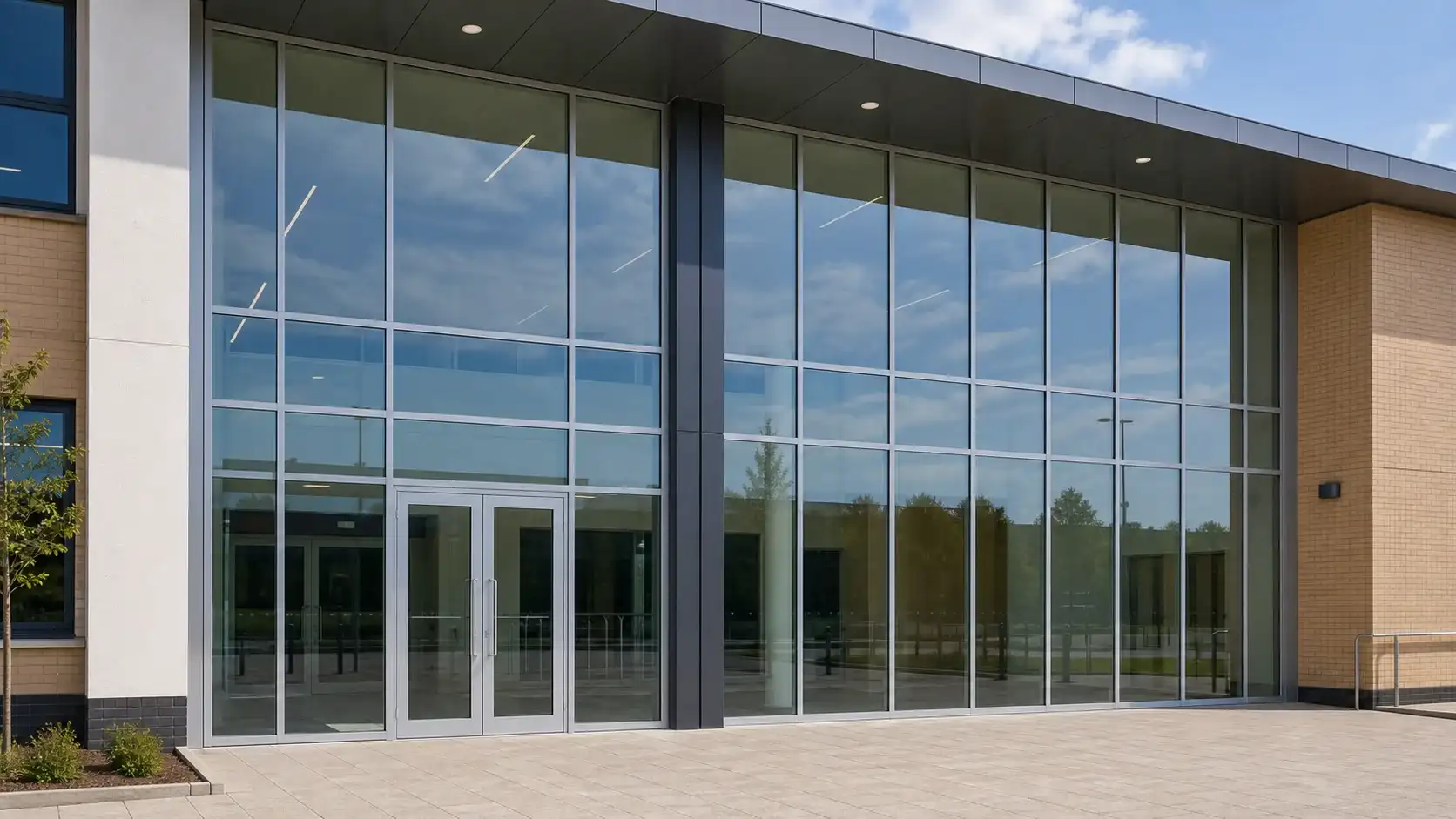
What Drives Aluminium Curtain Walling Cost
A trade buyer's guide to how curtain walling is actually priced — the cost anatomy, the variables that move a quote, and what a fabricator needs from you to return an accurate figure. Every curtain wall is bespoke, so this is the pricing logic, not a price list.
By Stephen Chappell, Managing Director, Kingsland Fabrications. For trade and commercial customers, including facade contractors, main contractors, installers and project teams. We supply and fabricate; we don't install.
Why this is a pricing guide, not a price list
"How much is curtain walling per square metre?" is the question every estimator wants answered in one number. The honest trade answer is that a single published rate would mislead you more than help you. Two elevations of identical area can quote a long way apart depending on the glass, the grid, how many opening vents sit in them and the finish — and a headline rate that ignores all of that is a number you can't price a tender against.
So instead of inventing a figure, we publish the logic we use to build a real quote. Curtain walling is the most spec-heavy product we fabricate. When you understand which decisions move the cost — and which barely touch it — you can shape the specification, brief your fabricator cleanly, and protect your margin before the order is placed.
Everything we make is bespoke and quoted from your survey or drawings. The rest of this guide is about giving us the information needed for an accurate quotation, not pretending a fixed price exists.
"The contractors who price curtain walling well aren't the ones chasing the lowest rate. They're the ones who hand over a clean spec and know exactly which decisions are driving their cost."
— Stephen Chappell, Managing Director
The cost anatomy of a curtain wall
A curtain walling rate isn't one number — it's a stack of layers. Knowing the layers tells you where a quote can move and where it can't.
Frame (per m²)
The aluminium mullion and transom profiles, cleats, brackets and gaskets. Driven by grid density and system choice — the JCW runs 50mm sightlines with three mullion and transom section options to match span and wind load.
Glass / infill
Sealed glazed units, spandrel panels and back-pans. Usually the largest variable cost, and the one most sensitive to performance targets. The JCW accepts glazing up to 32mm including acoustic units.
Fabrication labour
Cutting, machining, assembly and checking each frame section against the approved mullion, transom and component layout. Operable elements and complex modules add fabrication steps.
Finish
Polyester powder coat in single or dual colour across the full RAL range. Standard RAL is the baseline; dual-colour and specials add a coating pass.
Delivery
Palletised dispatch from our Warrington workshop to site, labelled by reference. Phasing and multiple drops add handling versus a single delivery.
For the terms behind these layers, the glazing and performance standards sections of our glossary explain the spec language that drives each one.
Stick vs unitised: the system choice behind the cost
One of the first questions that shapes a curtain wall budget is how the system is built up. The two broad approaches carry very different cost and programme profiles.
Stick-built curtain walling is fabricated as discrete mullion and transom sections, then assembled and glazed on site. JCW follows this route: frame sections are checked against the approved layout and prepared for the palletised delivery arrangement confirmed on the quotation. Your facade contractor assembles and glazes the system on site.
Unitised curtain walling is assembled and glazed into complete storey-height panels in the factory, then craned into place as finished units. It shifts labour off the scaffold and into the workshop, speeds site installation on tall buildings, and is the norm on high-rise — but the factory assembly and panel logistics raise the per-square-metre cost and it only pays back at scale and height.
Kingsland fabricates the stick-built JCW route, which spans up to 13 metres in height with three mullion and transom section options selected for the project span and wind load. If the specification requires a unitised system, confirm that route with the design team before quotation because it changes the system, interfaces and supply scope.
The seven variables that move a quote most
Plenty of decisions affect a curtain wall price. These seven move it the most — get them defined and a fabricator can quote with confidence; leave them vague and you'll get a cautious number with risk priced in.
Glass spec and U-value
The infill glass is often the single biggest line on a curtain wall order. A standard double-glazed low-E unit and a high-performance triple-glazed, solar-controlled, acoustic-laminated unit can sit a long way apart per square metre. Tighter whole-system U-value targets push you toward heavier build-ups, warm-edge spacers and coated panes — all of which carry the glass price upward and lengthen lead time.
Transom and mullion grid density
More frame per square metre means more profile, more cutting, more cleats and more sealing. A facade broken into many small panes carries more aluminium and more fabrication labour than the same area run as fewer, larger lights. The module you draw at design stage sets the metalwork cost for the whole elevation.
Opening vents and operable elements
Every opening vent, insert window or door tie-in inside the curtain wall is a separate sub-assembly with its own hardware, gaskets and weather detailing. Fixed glazing is the cheapest square metre on the elevation; each operable element added to it is a step up in both parts and labour.
Spandrel and infill zones
Opaque spandrel areas between floors are backed with a back-pan and insulation rather than vision glass, and on most commercial schemes now use non-combustible insulation. The build-up, fire-stopping interface and back-pan all change the rate for those zones versus clear vision panels.
Finish and dual-colour
A single standard RAL polyester powder coat is the baseline. Dual-colour (a different finish inside and out), non-standard RAL, anodised or special-effect finishes add a coating pass and cost. The JCW carries a single or dual-colour PPC finish across the full RAL range — the choice is a real line on the quote, not a free option.
Access, phasing and delivery
How the order is sequenced to site changes the supply cost. A single palletised drop to one address is straightforward; phased releases tied to a fit-out programme, multiple deliveries, or panels labelled and batched per elevation all add handling. We fabricate supply-only and deliver palletised throughout mainland Britain — your facade contractor fits on site.
Required date and sequence
Allow approximately 21 working days for general planning. The quotation confirms the current lead time, its start point, the exact date and any exceptions caused by glass availability, drawing approval, interfaces or phased releases.
Where contractors lose money on curtain walling
The margin on a curtain wall scope is rarely lost on the headline rate. It leaks out through the things that weren't pinned down before the order was placed.
- Incomplete shop drawings at sign-off. The most common cause of a slipped curtain wall is a drawing set that wasn't finished before fabrication started. Vague modules and undecided interfaces turn into variations later — and variations cost more than getting it right first time.
- Over-specified glass. Carrying a triple-glazed, acoustic, solar-controlled unit across an elevation that didn't need it is money spent for no benefit. Specify the performance the project requires, zone by zone — not the highest spec everywhere by default.
- Operable elements added late. Opening vents, insert windows and door tie-ins drawn in after the order are an expensive change. Each one is a separate sub-assembly — decide them at design-development stage, not during fabrication.
- Underestimated programme. Treating curtain walling as a late-procurement item can force re-planning of the trades that follow it. Allow approximately 21 working days for general planning, then use the current lead time, start point, exact date and exceptions confirmed on the quotation.
- Mixing up the product. Window walling, glazed shopfronts and curtain walling get specified interchangeably. The wrong product on the order is a slow, costly correction — push back at the specifier early if the terms are loose.
What we need for an accurate quotation
The cleaner the information coming in, the tighter the number going out. Send these and we can quote from your survey or drawings without a round of follow-up questions:
Architectural elevations
Drawn elevations with the module — mullion spacing and floor-to-floor arrangement — so we can take off the metalwork and grid density.
Glazing specification
IGU build-up and glass spec per pane: toughened, laminated, low-iron, low-E, solar-control or acoustic, plus any whole-system U-value target.
Structural design loads
The design wind pressure and any movement the structural engineer is allowing, so we can confirm the JCW section options suit the span.
Spandrel and fire zones
Where the opaque spandrel zones sit, the insulation requirement, and the building's compartment lines if fire-rated zones are involved.
Operable elements
Every opening vent, insert window and door tie-in, marked on the elevation — each is a separate sub-assembly we need to price.
Finish and delivery
RAL number (and whether it's single or dual-colour), the delivery address, and any phasing tied to your fit-out programme.
A worked example — how the same area quotes differently
To show the logic in action without inventing figures, take two elevations of the same area on two different schemes. The square metres are identical. The quotes are not — and here's why.
Elevation A — the lean spec
- Large fixed vision lights, generous module — less frame per m²
- Standard double-glazed low-E units throughout
- Modest spandrel zone with standard back-pan build-up
- No opening vents on the elevation
- Single standard RAL powder coat
- One palletised delivery to a single address
This sits at the lower end of the rate. It's mostly fixed glazing, mostly glass and frame, with little added labour.
Elevation B — the loaded spec
- Tighter module with many smaller lights — more frame per m²
- High-performance triple-glazed, acoustic, solar-control units
- Larger spandrel zone with non-combustible insulation
- Several opening vents and an insert door tie-in
- Dual-colour finish, different inside and out
- Phased delivery batched per elevation to suit the programme
Every layer is heavier — more aluminium, dearer glass, more sub-assemblies, an extra coating pass and more handling. Same area, materially higher quote.
Neither elevation is "right" or "wrong" — each is correct for its project. The point is that a per-square-metre headline would describe neither honestly. The accurate number comes from the spec, which is exactly why we quote from your survey or drawings rather than from a rate card.
Keep reading
JCW Curtain Walling
The system itself — 50mm sightlines, BS 6375-tested weather performance, glazing up to 32mm, supply-only to mainland Britain.
Trade Aluminium Fabrication
How we work as a made-to-order trade fabricator for installers, contractors and glaziers — doors, windows, shopfronts and curtain walling.
Supply-Only Trade Fabrication
What supply-only means in practice, where our work ends and your fit begins, and why it keeps your margin clean.
Aluminium Fabrication Glossary
The spec language behind the cost — start with the glazing and performance standards sections.
Got a curtain walling specification to price? Call 01925 500 295 or use the quotation form — send your elevations, glazing specification, delivery sequence and required date so we can prepare an accurate quotation.