
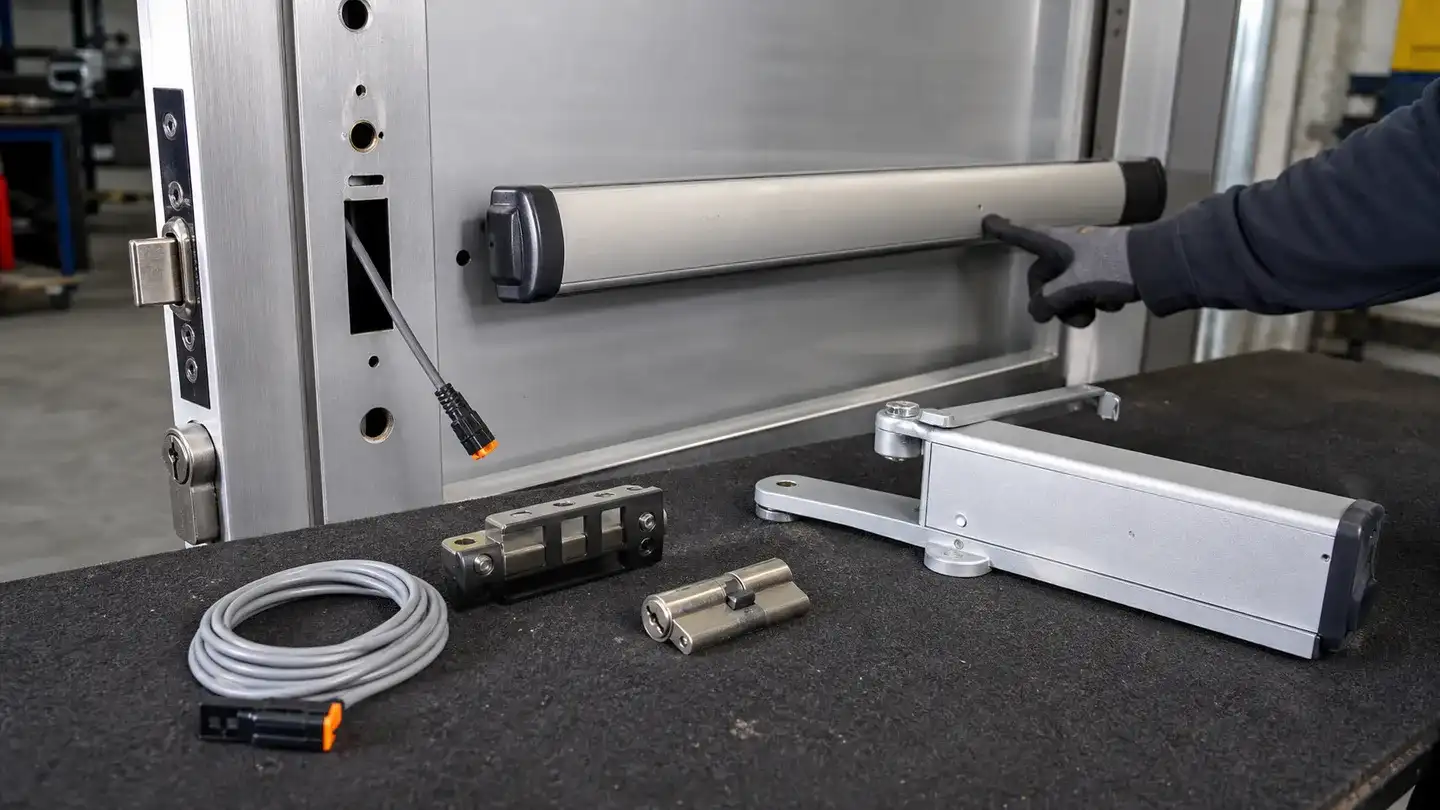
Commercial Aluminium Door Hardware and Security
A commercial aluminium door needs five hardware decisions settled before fabrication: how it closes (floor spring, transom closer or overhead closer to EN 1154), how it locks (a narrow-stile hookbolt or deadlatch with an anti-snap euro cylinder), how people escape (EN 1125 panic bars for public buildings, EN 179 devices for staff-only doors), how it meets Part M (opening forces, clear widths and thresholds), and any security certification or access control the project demands (PAS 24 or STS 202, a maglock or electric strike with concealed cable routes). Every lock case, pivot prep, spindle hole and cable route those decisions produce is CNC-machined into the profile before the corners are joined, so the hardware spec must be final at order stage — not decided on site. This guide covers each decision, the certification picture around PAS 24, STS 202, Document Q and Secured by Design, and the Part M accessibility limits that shape closer choice.
By Stephen Chappell, Managing Director, Kingsland Fabrications. Updated 3 July 2026. Supply only for trade and commercial customers; we don't install.
The short answer: five hardware decisions every commercial aluminium door needs
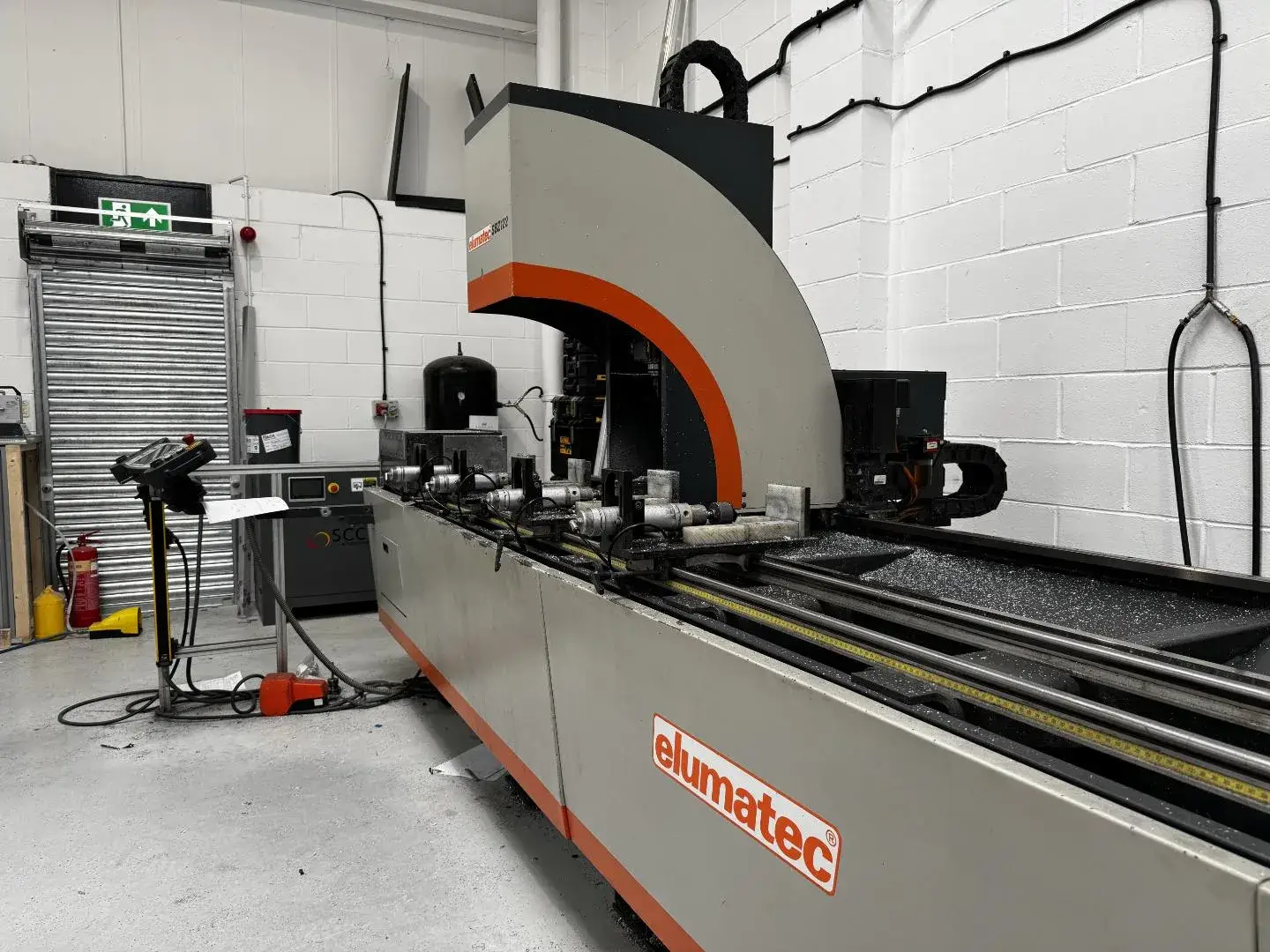
This is a specification reference for shopfitters, glazing companies, maintenance contractors and facilities teams ordering supply-only doors — not an installation manual or a hardware sales page. One rule frames everything below: every lock case, pivot prep, spindle hole and cable route is CNC-machined into the profile before the corners are joined. You cannot get a router into an assembled leaf, so the hardware specification has to be final at order stage.
Closing
Floor spring, transom closer or overhead closer, power-sized under EN 1154. Floor springs carry the heaviest double-action leaves; transom closers avoid cutting the slab; overhead closers cover back-of-house doors.
Locking
A narrow-stile lock case — hookbolt deadlock, deadlatch or swing bolt — plus a euro cylinder. The cylinder is the real attack point: specify anti-snap to a recognised standard such as TS 007.
Escape
On escape routes: EN 1125 panic bars or touch bars where the public uses the building, EN 179 lever or push-pad devices for trained staff only. One action, no key, no prior knowledge.
Accessibility
Part M opening forces, effective clear width and threshold height — requirements that pull directly against heavy closers on exposed sites, and must be resolved in the spec, not on site.
Certification and access control
PAS 24, STS 202 or Secured by Design where the project demands it, plus any maglock, strike or reader — declared at order so preps and cable routes are machined in before assembly.
Floor spring, transom closer or overhead closer?
Floor spring
Concealed in a floor box cut into the slab. Double-action capable, carries the heaviest leaves — the default for shopfront entrance doors. Spindle positions are machined into the leaf at fabrication.
Transom closer
Concealed in the transom bar above the leaf — no floor box needed. The retrofit answer where the slab cannot be cut.
Overhead closer
Surface-mounted, single-action, lowest cost. Right for back-of-house and secondary doors — not a high-traffic double-action entrance.
Closers are power-sized EN 1 to EN 7 under EN 1154 by leaf width and mass. As a working guide, a mid-range EN 3 suits leaves up to around 950mm and 60kg, and an EN 6 covers around 1400mm and 120kg — but the binding figures are on the closer manufacturer's datasheet, and exposed or windy elevations usually need one power size up. Electrically powered hold-open devices, released on the fire alarm, fall under EN 1155.
Leaf weight is dominated by glass — roughly 2.5kg per square metre per millimetre of thickness, so a 28mm unit with two 6mm panes carries about 30kg of glass per square metre before the aluminium is counted. The heaviest-duty floor springs carry leaves of several hundred kilograms; the TD68 commercial door we fabricate runs a bottom pivot rated to 250kg.
That is also the honest answer to "what is the maximum single leaf?" The practical ceiling is hardware capacity — spring rating, pivot load — and glass weight, not profile strength. The TD68 is tested to 1300mm wide by 3000mm tall on that pivot; anything beyond a system's tested maximums should be a conversation with the fabricator before it is promised to a client.
Can a new leaf be made to fit an existing floor spring and pivots?
Yes — a common replacement scenario: the leaf is beyond repair after an impact or break-in, but the floor spring and frame are sound. A new leaf can be fabricated with pivot preps matched to the existing spindle positions — no slab-cutting, no new floor box, no full doorset. Our replacement-order guide explains the information needed. To match an existing spring, a fabricator needs:
- Spring make and model — usually stamped on the cover plate or the box lid.
- Spindle shape and height, and the distance from the frame to the spindle centre.
- Top pivot type, leaf dimensions and the lock backset.
- Clear photos of the spring box, spindle and top pivot — with two or three measurements, normally enough to identify the set. Our survey checklist covers the rest.
Check the spring itself before ordering: oil weeping from the box, no check on the closing sweep, or the door slamming home all mean it is finished, and a new leaf hung on a dead spring wastes the visit. A new spring plus a new leaf is still usually cheaper than a full doorset if the frame is sound.
Pivot preps are machined to the measured spindle positions, and every swing door is assembled and function-checked on the workshop jig before dispatch as fabrication QC, not standards or certification testing.
"If the spring and the frame are sound, the client doesn't need a new doorset — they need a leaf machined to match what's already in the floor."
— Stephen Chappell, Managing Director
Panic and escape hardware: EN 1125 vs EN 179
EN 1125 covers panic exit devices — a horizontal push bar or touch bar anyone can operate in a single action with no prior knowledge — required where the public may use the escape route. EN 179 covers emergency exit devices — a lever handle or push pad — acceptable only where occupants are trained and familiar with the door.
Panic hardware fits narrow-stile aluminium commercial doors — touch bars suit narrow stiles particularly well. The constraints are the lock-case depth the stile can take, and using a device certified for the leaf's width and weight, so check the device datasheet against the door sizes. The TD68 also offers a concealed panic bar design where the spec calls for a cleaner face.
On a designated escape route the door must open in one action without a key — a deadbolt left thrown overnight defeats the panic device and the fire risk assessment. Outside access devices (OADs) resolve the tension: keyed entry from outside without compromising single-action escape from inside, which is how a shopfront fire exit stays both secure and compliant.
The detail that decides whether the fit goes smoothly: panic device fixing positions and lock cases are drilled to the hardware manufacturer's template at fabrication. Name the exact device — make and model — at order, so the preps in the leaf match what arrives in the installer's van.
Locks and cylinders: hookbolts, deadlatches and TS 007
Narrow-stile aluminium doors take purpose-made lock cases — Adams Rite-pattern hookbolt deadlocks, deadlatches and swing bolts. A domestic mortice lock physically does not fit: the stile is too shallow for its case depth, and the backset (door edge to cylinder centre) is far shorter on a narrow-stile case. Specify the lock by type and backset, not by analogy with a timber door.
On pivot and sliding doors, hookbolts win: the hook engages the keep so the leaf cannot be spread or levered off it with a bar — the most common shopfront attack — where a straight deadbolt resists less well. On hinged commercial doors a deadlatch or multipoint case may suit better; the TD68 takes motorised multipoint locking where the spec calls for higher security or a PAS 24-configuration build.
The cylinder is the real attack point, not the lock case. Cylinder snapping — breaking a protruding euro cylinder at its weak centre to reach the cam — defeats a good case with a cheap cylinder in it. The spec answer is TS 007 star ratings (a 3-star cylinder, or a 1-star cylinder behind 2-star protective furniture) or Sold Secure SS312 Diamond.
For maintenance companies running multi-door sites, cylinders are also logistics: keyed-alike and master-keyed suites, and restricted key profiles that stop uncontrolled copying. State the cylinder spec at order and the door arrives ready to suite.
PAS 24, STS 202, Document Q and Secured by Design: what commercial doors actually need
PAS 24
An enhanced-security test standard for complete doorsets — pass or fail against a defined attack. It certifies a tested configuration, not a system in the abstract.
Approved Document Q
The Building Regulation mandating PAS 24-level performance — for new dwellings. A standard shop entrance has no automatic legal PAS 24 requirement.
STS 202 and LPS 1175
Graded attack-resistance certifications from Warringtonfire and BRE, used by insurers and specifiers for commercial premises — a different animal from PAS 24’s pass/fail dwelling focus.
Secured by Design
The police-backed scheme, not a test standard itself — it requires products tested to PAS 24 or an equivalent, invoked by planning conditions and specifiers.
The misunderstanding worth correcting head-on: because Document Q applies to new dwellings, most shopfronts have no legal PAS 24 obligation at all. PAS 24 bites commercially where the door serves dwellings — communal entrances to flats in mixed-use schemes, student accommodation — and wherever a specifier, planning condition or Secured by Design requirement invokes it. Insurers tend to ask for graded attack-resistance ratings instead; the TD68 carries STS 202 BR2 accreditation alongside PAS 24 testing, with Secured by Design compliance when built with approved hardware.
The honest fabricator point: certification belongs to a tested doorset configuration — a specific hardware list, glass build-up and size range — not to the aluminium system in the abstract. A certificated door must be fabricated to the tested spec, so confirm the tested configuration for the specific system at quote stage; if an insurer demands a rating, the complete doorset must be certificated, not just the lock. And when a tender just says "secure" or "SBD compliant", translating that line into a buildable hardware list is a conversation, not a checkbox — have it before the order, not after delivery.
Accessibility: Part M opening forces, clear widths and thresholds
Approved Document M and BS 8300 cap how hard a door can be to push open at the leading edge — the commonly applied limits are 30N from closed to 30 degrees open and 22.5N from 30 to 60 degrees. Those low numbers collide directly with the closer sizing above: a windy corner site wants an EN 5–6 closer, accessible opening forces want the opposite. The resolutions are a low-energy automatic operator (to EN 16005), delayed-action or backcheck closer functions, or accepting a powered accessible entrance. Pretending both demands can be met with one heavy spring is how doors fail their access audit.
Effective clear opening width has the same trap. The minimum varies by approach direction and building type, and the width on the drawing is not the width in practice — stile choice, panic hardware projecting from the leaf face and the door standing open at 90 degrees all eat into it. Check the effective figure, not the structural opening.
Accessible entrances need level thresholds — or, where a raised threshold is unavoidable, a total height of no more than 15mm with exposed edges chamfered or rounded — and a level threshold trades away weather performance on exposed elevations, so the drainage detail matters; our threshold and level-access guide covers that decision in full. Finally, double-action pivot doors in public buildings should carry anti-finger-trap stiles — rounded meeting edges that close the shear gap at the pivot edge. A curved finger guard is standard on the TD68 for exactly this reason.
Maglocks, electric strikes and access control: prep at fabrication, not on site
The options map simply. Electromagnetic locks are fail-safe — they release on power loss — with holding forces rated in the hundreds of kilograms: the usual choice for controlled entrances and communal doors. Electric strikes and electric-release deadlatches come fail-safe or fail-secure and suit office entrances where a mechanical lock stays in play. Solenoid and motor locks cover higher-security specs; the TD68 supports electromagnetic locking with TOTAL, LIGHT and FREE access modes for different states through the trading day.
The escape-route rule: an electronically locked door on an escape route needs fail-safe release wired to the fire alarm in line with BS 7273-4, plus a manual override such as a break-glass unit. The access control installer owns that wiring — but the door must be built to accept it.
Which is the fabrication point of this whole page: cable ways routed through the profile, apertures for readers and keypads, transfer loops or electric transfer at the pivot — all machined before assembly. Site-drilling a finished powder-coated leaf for a maglock risks damaging it. State the access control make and model at order — or at minimum "maglock + door position switch + reader on the pull side" — and the doorset arrives prepped for the security installer, with CAD drawings showing every prep position for sign-off before anything is machined. Allow approximately 21 working days for general planning. The quotation confirms the current lead time, its start point, the exact date and any product- or specification-specific exceptions.
Not sure what the specification means, or what spring is under an existing door? Send photos of the door, spring box and lock stile over WhatsApp or the contact form. We will review the hardware with you before anyone commits to the order, then prepare a quotation with CAD drawings where required.
Frequently asked questions
Can panic exit hardware be fitted to aluminium commercial doors?
Yes. Narrow-stile aluminium doors take purpose-made panic hardware — touch bars suit narrow stiles particularly well — certified to EN 1125 for buildings the public uses, or EN 179 where only trained staff use the door. The critical part is preparation: the fixing holes and lock case are machined to the device manufacturer's template during fabrication, so name the exact make and model when you order the door.
Do commercial shopfront doors need PAS 24 or Document Q compliance?
Not usually by law. Approved Document Q mandates PAS 24-level security for new dwellings, so a shop entrance has no automatic PAS 24 requirement. It applies commercially when the door serves a dwelling — communal flat entrances in mixed-use buildings, for example — or when a specifier, planning condition or Secured by Design requirement invokes it. Insurers more often ask for attack-resistance ratings such as STS 202 or LPS 1175, and any certification applies to the complete tested doorset, not the lock alone.
Can a new aluminium door be made to fit an existing floor spring?
Yes — this is routine replacement work. If the floor spring and frame are sound, a new leaf can be fabricated with pivot and spindle preps matched to the existing positions, avoiding cutting the slab for a new floor box. The fabricator needs the spring make and model (usually on the cover plate), the spindle position and shape, the top pivot type and the leaf sizes — clear photos plus a few measurements are normally enough. If the spring is weeping oil or no longer checks the door, replace it in the same visit.
What is the maximum size for a single leaf aluminium commercial door?
The limit is usually hardware, not aluminium. Leaf weight — dominated by the glass — has to sit within the floor spring or pivot rating, and closer power sizes run out as leaves get wider, so commercial single leaves are normally kept within the sizes the systems house has tested. Unusually wide or tall leaves need heavy-duty pivots, thicker glass drives weight up quickly, and anything outside the system's tested maximums should be a conversation with the fabricator before it is promised to a client.
Do maglocks comply with fire escape requirements?
They can, if specified correctly. Maglocks are fail-safe — they release when power is cut — which is why they are accepted on escape routes, but the release must be wired to the fire alarm in line with BS 7273-4 and backed by a manual override such as a break-glass unit. That wiring belongs to the access control installer; the door's job is to arrive with the cable routes and fixing preps already machined in, which is why access control should be declared when the door is ordered.
Should a shopfront door have a hookbolt or a deadbolt?
For pivot and sliding doors, a hookbolt. The hook engages the keep so the leaf cannot be spread or levered away from the frame with a bar — the most common attack on shopfront doors — where a straight deadbolt resists less well. On hinged commercial doors a deadlatch or multipoint case may suit better. In every case the euro cylinder is the real attack point, so fit an anti-snap cylinder to a recognised standard such as TS 007 whichever lock case you choose.
Keep reading
TD68 Commercial Aluminium Doors
The heavy-duty system behind much of this guide — 250kg pivot, STS 202 BR2, PAS 24, panic and access control compatible.
JD47 Shopfront Doors
Slimline retail doors, floor spring or pivot hung, glazed and beaded in the workshop, with narrow-stile lock cases.
Door Thresholds & Level Access
The threshold decision in detail — level access, weather performance and the Part M trade-offs.
Replacement Survey Checklist
What to measure and photograph on a replacement survey — including floor spring, spindle and pivot details.
Got a door specification to settle? Call 01925 500 295 or use the quotation form — send your sizes and hardware specification and we will prepare a quotation.