
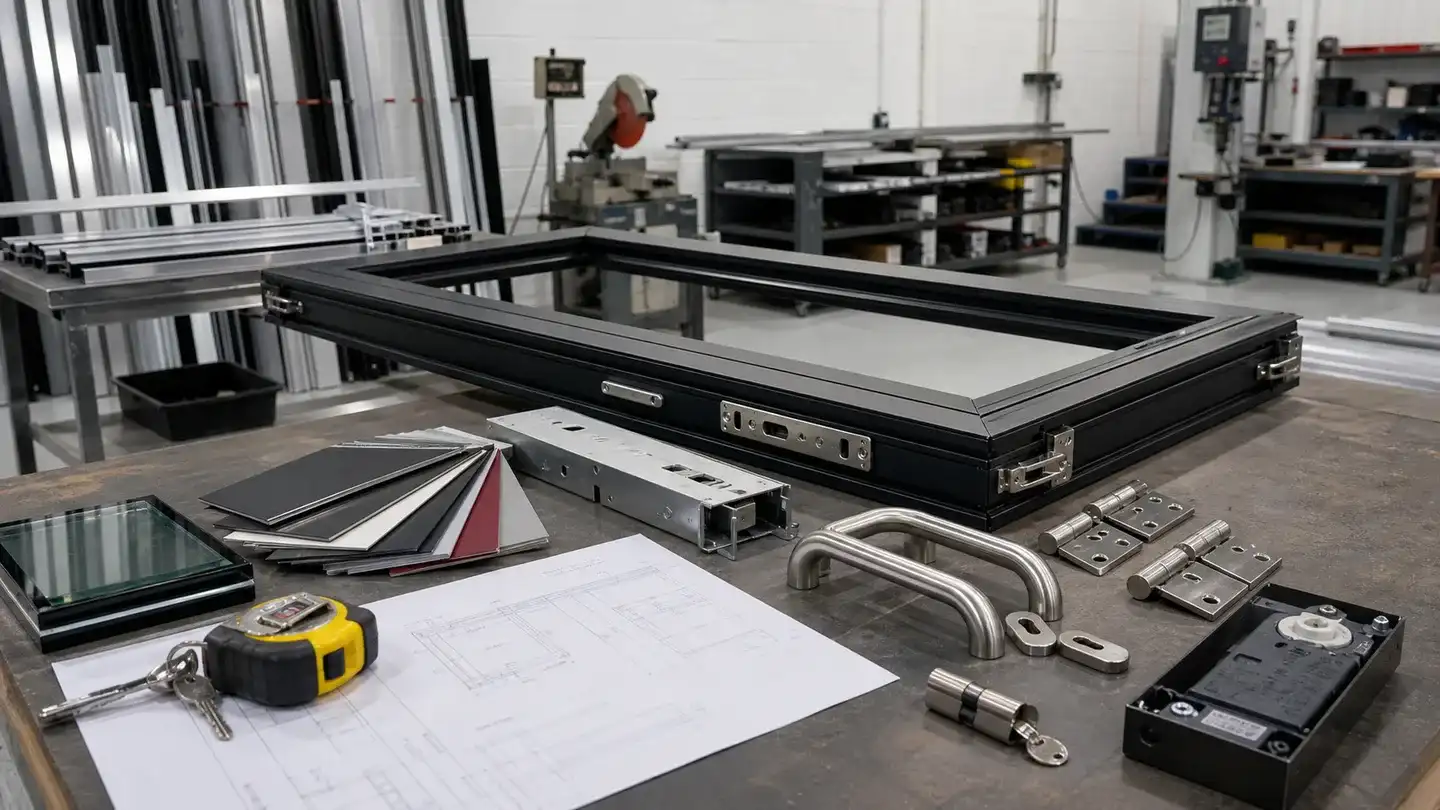
Commercial Aluminium Door Prices: A Supply-Only Trade Guide
What a replacement commercial aluminium door costs in the UK is set by its specification, not by a rate card. Leaf size and weight, thermal break, glass spec, hardware preps and colour each move the number — and a leaf-only replacement costs materially less than a complete doorset. Everything we quote is supply-only and ex VAT, excluding installation. This guide is the pricing logic we use to build a real quote, so you can budget before you have one.
By Stephen Chappell, Managing Director, Kingsland Fabrications. Updated 3 July 2026. Supply only for trade and commercial customers; we don't install.
How much does a replacement commercial aluminium door cost?
The honest trade answer: it depends on what you are actually buying — and two doors that look identical in a photo can quote a long way apart. A plain hinged leaf in a stock colour and a leaf machined for a floor spring, panic device and midrail lock are different fabrication jobs, even at the same size. That is why we quote each door individually from your sizes and spec rather than publishing a price list that would mislead more than it helps.
What we can publish is the structure of the number. Every commercial door quote is built from the same ladder of configurations, cheapest to dearest, with the same set of add-ons moving each rung up. Learn the ladder and you can budget a job — and sanity-check anyone else's quote — before a fabricator has priced it.
Single leaf only
A replacement leaf fabricated to size, hardware fitted or prepped to template, hung into the existing frame by your installer. The least aluminium and the least fabrication — the bottom of the range when the existing frame is sound.
Single doorset
Leaf plus outer frame as a complete fabricated order: the standard replacement when the frame is tired or the thermal spec is changing. More profile, more machining and more hardware than a leaf alone, so it costs materially more.
Rebated double doorset
A pair of leaves meeting on a rebate, plus frame. Two leaves to fabricate, hardware in both, and the meeting-stile detail to machine — the dearest standard configuration before add-ons.
The add-ons
Each of these moves any configuration up: a midrail, panic hardware preps to EN 1125, a floor spring prep versus a transom or overhead closer, the thermally broken system over the non-thermal one, and non-stock or dual colours.
We fabricate both systems this ladder runs on: the thermally broken TD68 commercial entrance door and the non-thermal JD47 shopfront door — both Jack Aluminium systems, made to order in our Warrington workshop. Send sizes and the specification and we will prepare a supply-only quotation, with CAD drawings where required.
What drives the price of a commercial aluminium door
Ranked by how hard each one moves the quote. Pin these five down and a fabricator can price with confidence; leave them vague and you get a cautious number with risk built in.
Leaf size and weight
A bigger leaf means more profile, more glass and a heavier assembly — and a heavier leaf needs higher-rated hardware to carry it. Our TD68 commercial door runs a bottom pivot rated to 250kg and has been tested to 1300mm x 3000mm, but the closer to those limits you specify, the more the leaf, the pivot set and the closer all cost. Oversized leaves are the single fastest way to move a door quote upward.
Thermal break — or not
A thermally broken door like the TD68 carries a polyamide break in the profile and costs more in aluminium than a non-thermal shopfront door like the JD47. Where the opening sits in a heated trading space, Document L pushes you toward the thermal system; a lobby door, an internal opening or some shopfront replacements can run non-thermal. Matching the system to the requirement — rather than defaulting to the dearer one — is real money.
Glass specification
Toughened glass is the minimum for a commercial door; laminated adds security and cost; and the sealed-unit build-up moves with the thermal target — the TD68 accepts glazing from 24mm to 44mm. Where we glaze and bead in the workshop, the glass is a line on our quote; the heavier the spec, the bigger the line.
Hardware prep complexity
The non-obvious one. Hardware prep is fabrication labour: a leaf machined for a floor spring, a concealed vertical rod panic device and a midrail lock case costs meaningfully more to produce than a plain hinged leaf — regardless of what the hardware itself costs. Every cut-out, every prep to template, is workshop time priced into the door.
Finish and colour
A single standard RAL polyester powder coat is the baseline. Non-stock RAL colours, dual colour (a different finish inside and out) and special finishes add a coating pass and time — applied through a Qualicoat-approved supplier. The colour decision rarely dominates a door quote, but it is never free.
"Two doors that look the same in a photo can be a long way apart on a quote. The difference is nearly always in the machining — send us the hardware spec with the sizes and there are no surprises on the number."
— Stephen Chappell, Managing Director
Leaf-only or full doorset: the replacement decision
For a maintenance contractor pricing a replacement, the biggest single fork in the cost is whether the job is a new leaf into the existing frame or a complete doorset. The leaf-only route is genuinely cheaper — less aluminium, less fabrication, a one-visit swap. But it is only cheaper when the existing frame deserves to stay.
When leaf-only is the right call
- The frame is sound, square and firmly fixed
- The thermal spec of the new leaf matches the frame
- Pivot centres and hardware positions can be replicated
- The threshold is intact and staying
- The client wants the entrance back in service in one visit
This is the bottom of the range: one leaf, fabricated to size, hardware prepped to template, hung and handed back.
When leaf-only is false economy
- The frame is racked, corroded or working loose in the reveal
- A thermally broken leaf is going into a non-thermal frame — a mismatch that undermines the point of the upgrade
- The threshold needs rebuilding for level access anyway
- Pivot centres are non-standard and can't be matched cleanly
- The repair history says the opening, not the leaf, is the problem
A new leaf in a failing frame buys the client repeat call-outs. Price the doorset, show the repair history against it, and let the numbers make the argument.
Either way, the accuracy of the quote lives in the survey. Before you send anything, capture:
- Sizes at three points — width at top, middle and bottom; height at both jambs and centre. Old openings are rarely square, and the smallest figures govern.
- Pivot centres and hinge positions — so the new leaf drops onto the existing gearing without site modification.
- The hardware spec — lock case, closer type (floor spring, transom or overhead), any panic device, and the cylinder arrangement.
- Photos — the full leaf, the frame corners, the threshold and the hardware, inside and out. A photo answers spec questions before we have to ask them.
Our replacement survey checklist covers the full measure sheet, and our replacement-orders page explains the supply-only process.
Aluminium vs steel doors for high-traffic commercial entrances
We fabricate aluminium, so read this knowing where we sit — and judge us on the fact that we will tell you plainly where steel is the better buy. Both materials have earned their place on commercial buildings; the mistake is specifying by habit rather than by opening.
Where steel wins
- Raw security on solid, unglazed leaves — a welded steel doorset is hard to beat for brute resistance
- Plant rooms, substations and rear-of-house service doors
- Fire-exit doorsets where a solid leaf is all the brief asks for
- Budget solid doorsets — for a plain unglazed door, steel usually costs less
Where aluminium wins
- Glazed entrances — glass is designed into aluminium systems, not cut into them
- Corrosion: aluminium doesn't rust, and UK commercial aluminium doors are mechanically joined with cleats and crimped corners rather than welded — no weld points for coating failure and rust bleed
- Slim sightlines and the full RAL range for frontages that trade on appearance
- Lighter leaves work the pivots, springs and closers less over thousands of cycles
- Repairability — a damaged glazed aluminium door can often take a replacement leaf into the existing frame
The recommendation logic is short: if the brief is a glazed trading entrance, aluminium; if it is a solid security door on a service yard, steel. Security ratings run on both sides — our TD68 is tested to PAS 24 with STS202 BR2 accreditation, so a glazed aluminium entrance is not the soft option it is sometimes painted as — but a solid steel leaf still takes the raw-security crown, and we would rather say so than sell you the wrong door.
What's included in a supply-only doorset
When you compare quotes, compare what is actually included. A supply-only doorset from our workshop includes:
- Fabricated leaf and frame, with every swing door assembled and function-checked on the workshop jig before dispatch as fabrication QC.
- Hardware fitted or prepped to template — locks, closers and panic preps machined in the workshop, not improvised on site.
- Glazed and beaded where specified, with the quotation confirming the beads, gaskets, fixings, hardware and loose items included.
- A CAD drawing where required, so the manufacturing detail can be approved before fabrication.
- A labelled order on a pallet, delivered from our Warrington workshop throughout mainland Britain — England, Wales and Scotland.
And what is not included, stated plainly so there are no surprises at invoice: installation — we supply and fabricate; we don't install. Disposal of the old door — that stays with you or your client. And on automatic entrances, the operator itself — we fabricate frames prepped to the operator manufacturer's spec, and your installer fits the automation.
Lead time for a replacement commercial door
Allow approximately 21 working days for general planning. The quotation confirms the current lead time, its start point, the exact date and any product-, finish-, glass- or hardware-specific exceptions.
Kingsland fabricates the permanent replacement to order after the site team has secured and surveyed the opening. A complete survey — sizes at three points, hardware detail and useful photos — helps us quote without avoidable follow-up questions. Our aluminium fabrication lead-times guide explains the process, and our replacement-orders page covers the trade-supply boundary.
Frequently asked questions
How much does a replacement aluminium shop door leaf cost?
It depends on the leaf size, hardware preps, glass and colour — which is why we quote each door individually rather than publish a rate. A leaf-only replacement in a stock colour with standard hardware preps sits at the bottom of the range; panic hardware preps, midrails, laminated glass and non-stock RAL colours move it up, and a complete doorset costs materially more than a leaf alone. Send sizes, the hardware detail and photos where they help explain the existing door.
Why do commercial aluminium doors cost more than residential ones?
Heavier-gauge commercial profile, higher-rated hardware — floor springs and closers engineered for hundreds of cycles a day — toughened or laminated glass as standard, and machining for commercial lock cases and pivots. A residential door that looks similar is not built for the traffic.
How much does panic hardware add to a door?
Budget for two things: the device itself and the fabrication prep. A single-leaf push-bar arrangement to EN 1125 is the simpler machining job; concealed vertical rod (CVR) arrangements on rebated pairs need precise machining in both leaves and cost meaningfully more to fabricate. The prep is workshop labour, priced into the door rather than added at the end — so tell us the panic spec when you ask for the quote, not after the order.
Is a steel door cheaper than an aluminium one?
For a solid, unglazed doorset, usually yes — steel wins on raw cost and raw security, which is why plant rooms and service yards get steel. For a glazed trading entrance, aluminium is normally the more economical route once the glazing is accounted for, and it will not rust or need repainting.
Do your quotes include fitting?
No — every quote is supply-only and ex VAT. You keep the installation work and customer relationship while Kingsland fabricates to the approved information.
Keep reading
TD68 Commercial Aluminium Doors
The thermally broken system — PAS 24 and STS202 BR2 tested, 250kg pivot capacity, with swing doors assembled and function-checked on the workshop jig before dispatch. The workshop check is fabrication QC, not product certification testing.
JD47 Shopfront Doors
The non-thermal slimline option for retail frontages — 6–28mm glazing, floor spring or pivot hung, curtain wall compatible.
Replacement Fabrication
How we fabricate replacement leaves and doorsets for maintenance contractors and facilities teams — from survey to palletised order.
Replacement Survey Checklist
The measure sheet that gets a replacement door quoted accurately first time — sizes, pivot centres, hardware and photos.
Pricing a specific door? Ranges set budgets; specifications set prices. Call 01925 500 295 or use the quotation form — send your sizes, hardware specification and a photo only if it helps explain an existing door. We will talk through leaf-only or complete-doorset options and prepare a quotation.