
Replacement & Maintenance
Replacing a Failed Commercial Aluminium Door: Survey, Spec, and Supply Timeline
Practical guidance for maintenance contractors: make the opening safe, survey a failed commercial aluminium entrance and order a made-to-measure replacement against the confirmed lead time.
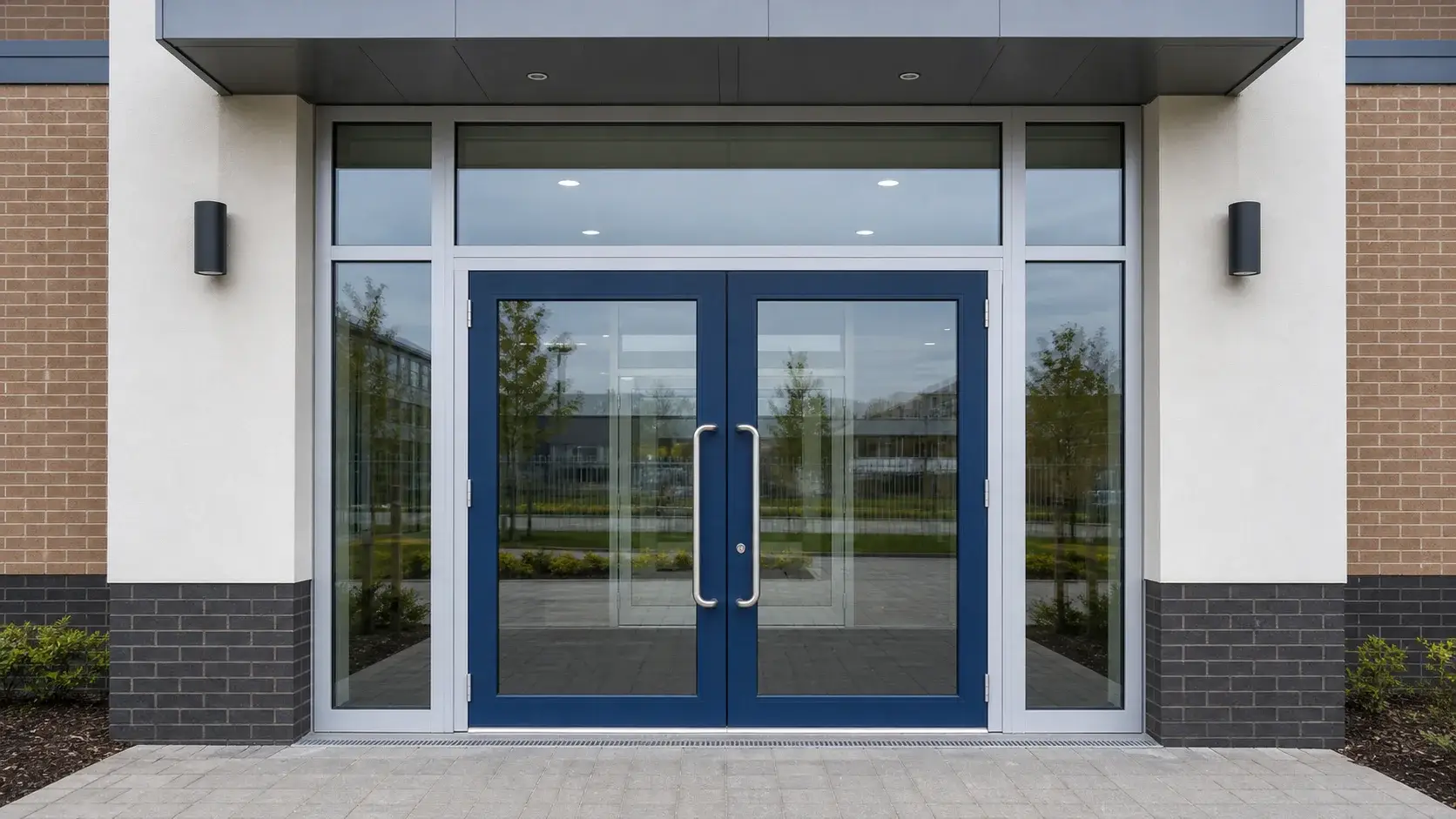
The phone rings on a Monday morning. A retail unit, office reception or school lobby has had its main aluminium entrance fail. The maintenance company has a ticket open and a margin to protect. The opening must be made safe first; the permanent replacement then follows the confirmed fabrication lead time.
This guide explains that handover from the supply side: what to record on site, what the fabricator needs and how to plan the replacement without promising a date before the product has been reviewed.
Stage 1: secure the opening and record the failure
Standard reactive procedure — board up, secure the opening, document the failure. Two things we’d add from the fabrication side:
- Photograph everything before you remove anything. The full leaf face, the frame on both sides, the threshold, the head detail, the hardware (closer, lock body, hinges/pivots), and the failure point. The photos drive the replacement spec.
- Don’t dispose of the failed leaf yet. If you can’t tell the system from the photos alone, the failed unit is the easiest reference. We’d rather identify the system from a photo of the original than guess.
If the failure is glass-only and the frame is intact, you may not need a replacement leaf — just a re-glaze. Confirm before you order new fabrication.
Stage 2: complete the replacement survey
A clean survey is what we need to fabricate. The minimum viable survey for a single-leaf commercial entrance:
- Outerframe size (head to threshold, jamb to jamb, inside-face to inside-face — measure three times, take the smallest)
- Leaf size (top to bottom, hinge edge to lock edge — measure the leaf, not the opening)
- Frame depth (how deep is the frame profile front-to-back?)
- Glass spec (thickness, IGU build-up, toughened/laminated)
- Threshold type (100mm, 150mm, drained — what’s there now?)
- Hardware schedule (lock type and cylinder, closer, hinge/pivot, panic bar, finger guard, kick plate)
- Hand of door (opening direction from inside the building)
- Finish — RAL colour or PPC reference. Take a colour photo in daylight.
Send all of that with the failure photos. If the survey is partial, we can sometimes fabricate from photos alone for a like-for-like — but the lead time gets longer because we need extra confirmations.
Stage 3: quotation and approval
You send the survey, the photos, and a brief on what the customer needs (like-for-like or upgrade — security, thermal, accessibility?).
Once the information has been reviewed, the quotation should confirm:
- A trade quotation (price, lead time, what’s included)
- A CAD drawing of the proposed replacement leaf with sizes, threshold type and hardware schedule for sign-off
- Any deviations from the original we’re flagging — e.g. if the original looks like a 25-year-old system that’s not still in production, we’ll propose a current-system equivalent
You confirm the quotation and approve any required fabrication drawing. The quotation remains the source of truth for the lead-time start point.
Stage 4: fabrication
Allow approximately 21 working days for general planning. The quotation confirms the current lead time, its start point, the exact date and any hardware, glass, finish or product-specific exceptions.
The site team handles immediate safety and any temporary closure. Kingsland then fabricates the permanent replacement to the confirmed made-to-order programme.
See the commercial door replacement lead-time guide for the approved product figures and the details that can move the date.
Stage 5: dispatch and delivery
The replacement leaf (or full doorset, depending on what’s failed) leaves the workshop:
- Assembled and function-checked on the workshop jig against the approved fabrication information; this is a QC check, not certification testing
- Pre-glazed and gasketed in the workshop where specified
- Labelled by opening reference where required
- Wrapped for transit
- Supplied with the fixings, gaskets, hardware and loose items stated on the quotation
Delivery can be made to your depot or directly to site. The delivery date and any access requirements are agreed with the order.
Stage 6: fitting
Your installer fits the product. Where specified, swing-door leaves are pre-glazed and gasketed, then assembled and function-checked on the workshop jig before dispatch. This is workshop fabrication QC, not standards or certification testing. See what we check before dispatch for the workshop process.
If anything is off — wrong size, wrong threshold or wrong finish — call us before altering the product. That gives the workshop the chance to understand the issue and agree the correct next step.
Margin protection — the hidden costs to watch
Replacement-job margin lives or dies on three things:
- Survey errors. A wrong dimension can turn a planned replacement into site adjustment, rework or a remake. Measure at three points and record which size governs.
- Hardware substitution. If the original lock cylinder isn’t still made, the replacement cylinder may need a new keep on the frame. Tiny detail, big rework if the keep doesn’t match. We flag substitutions on the CAD drawing — sign them off knowing the implication.
- Finish mismatch. RAL numbers age. A 10-year-old RAL 7016 doesn’t look identical to a fresh RAL 7016 powder coat. For visible facades, your end-client may notice. Either accept the variance, repaint adjacent units to match, or budget for finish-blending where possible.
The fabricator can mitigate all three with clear quoting, but the maintenance contractor controls the survey. Get that right and the rest of the chain is straightforward.
How we work with maintenance contractors
Replacement fabrication is welcome. We accept survey-led enquiries and single-opening orders, with no minimum order value. We supply trade and commercial customers for their team or appointed contractor to install.
If you are a maintenance contractor looking for a fabrication supplier, send a survey from a recent call-out and request a quotation. We will confirm the suitable product, missing information and current lead time. There is no commitment beyond that first quotation.
If you’re switching from another fabricator mid-contract, read how to switch aluminium fabricator without losing the job for the handover checklist we recommend before the first PO.