
Product Spec
RD70 vs SD70 vs TD68: Which Entrance Door System Do You Actually Need?
Jack Aluminium RD70, SD70 and TD68 entrance door systems compared for trade installers — thermal performance, security, aesthetics, and when to specify each on residential, heritage and commercial openings.
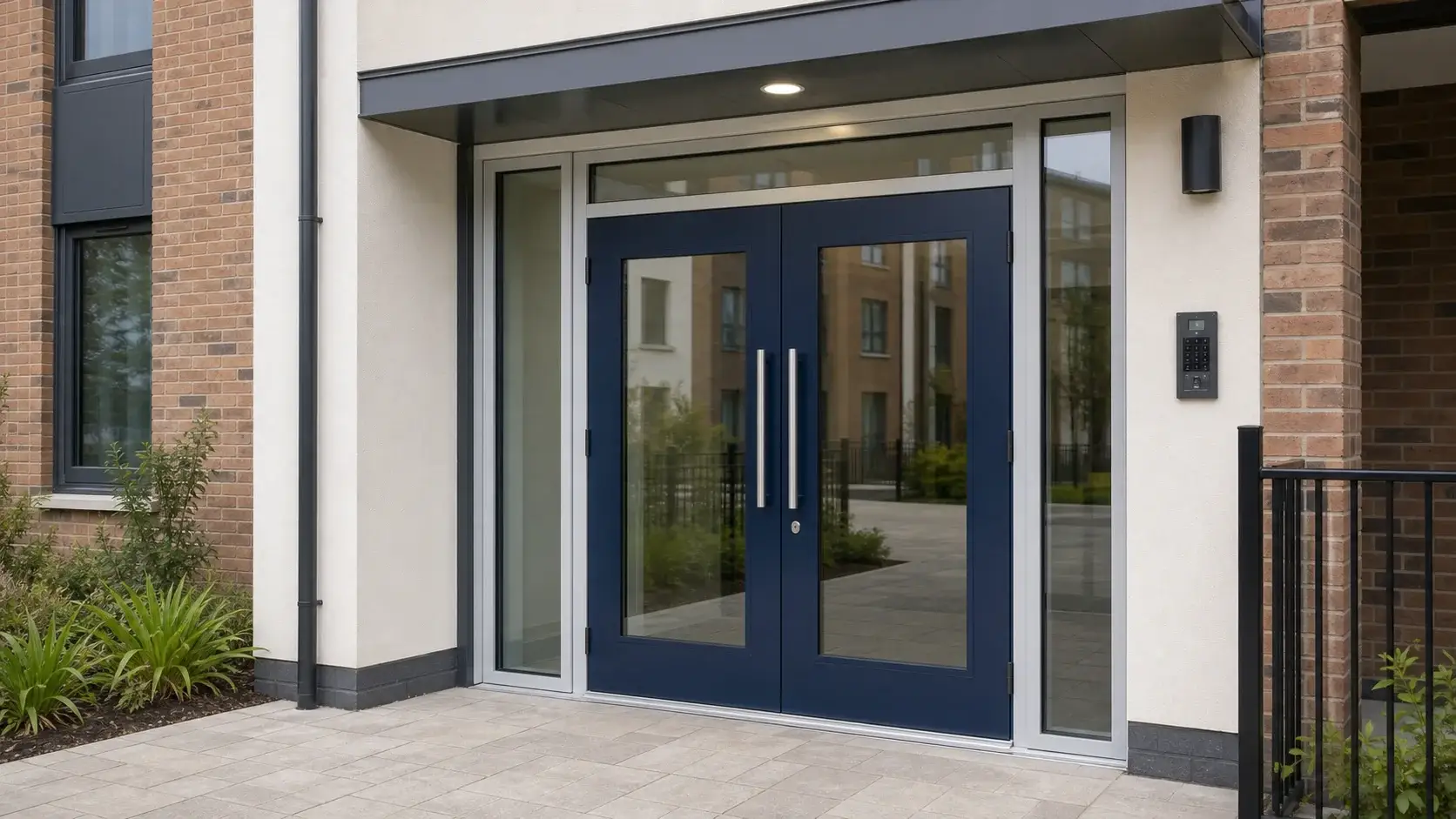
Installers often inherit a door schedule that says “aluminium entrance door” and nothing else. The architect may not have specified a system code. The client may point at a heritage-style door on a terraced house and ask for “the same but bigger” on a shopfront — which is a different product family entirely.
We fabricate RD70, SD70 and TD68 entrance doors daily in Warrington. This is the trade decision guide: which Jack Aluminium entrance system fits which opening, and what you should push back on when the spec is wrong.
Quick comparison
| RD70 | SD70 | TD68 | |
|---|---|---|---|
| Primary use | Residential & light commercial entrances | Heritage / conservation-style entrances | Heavy-duty commercial entrances |
| Frame depth | 70mm thermally broken | 70mm thermally broken | 68mm thermally broken |
| Thermal focus | High — U-value from ~1.5 W/m²K | High — slim heritage aesthetic | Moderate — security & traffic priority |
| Security | PAS 24 capable | PAS 24 capable | PAS 24, STS202 BR2, SBD options |
| Max tested size | Residential scale | Residential / light commercial | 1300mm × 3000mm; 250kg pivot |
| Typical buyer | Installer on dwellings, conversions | Conservation area refurb | Shopfitter, contractor, facilities or property team |
For how these systems tie into shopfronts and curtain walling, see Jack Aluminium compatibility.
RD70 — thermally broken residential entrance
Specify RD70 when: the opening is a dwelling, apartment entrance, or light-commercial door where Part L / Document L thermal performance matters and sightlines can be standard residential proportions.
RD70 is a 70mm thermally broken entrance system with PAS 24 accreditation available. U-values from approximately 1.5 W/m²K depending on glazing specification. It suits front doors, side entrances, and multi-unit residential schemes where the building regs thermal line is non-negotiable.
Do not specify RD70 when: the door is a high-traffic retail entrance with panic hardware, heavy pivots, and daily abuse from trolleys and crowds. That is TD68 territory.
Trade supply: residential entrance doors.
SD70 — heritage slim-line entrance
Specify SD70 when: the project is in a conservation area, period streetscape, or heritage refurb where the client wants slim sightlines and traditional proportions without switching to timber.
SD70 delivers heritage aesthetics in aluminium — thermally broken 70mm profiles with slimmer visual weight than RD70 on suitable openings. Planners often engage more easily with aluminium heritage systems than full modern commercial sections — though every conservation officer is different; always confirm with the planning case officer.
Do not specify SD70 when: you need maximum security credentials for a public building, or large-format commercial leaves over tested TD68 dimensions.
Trade supply: manual aluminium doors.
TD68 — heavy-duty commercial entrance
Specify TD68 when: the opening is commercial, high-traffic, public-facing — offices, retail, schools, healthcare, transport hubs — and security, durability and hardware integration matter more than residential thermal headline figures.
TD68 credentials include:
- PAS 24 and BS EN 6375 weather testing
- STS202 BR2 security rating
- Secured by Design when specified with approved hardware
- 250kg pivot capacity for large, heavy leaves
- Glazing from 24mm to 44mm
- Manual or automatic operation with concealed operators
For retail-specific hardware schedules and traffic assumptions, see commercial entrance door spec for high-traffic retail.
Do not specify TD68 when: the job is a dwelling entrance where Document L thermal targets drive the spec and commercial hardware is unnecessary — you are over-engineering and over-pricing the opening.
Trade supply: commercial entrance doors.
Common specifier mistakes
1. TD68 on a house because “commercial feels stronger.” Strength is not the only variable. Thermal compliance and proportion matter on dwellings.
2. RD70 on a shopfront because “it is cheaper.” Shopfront traffic and security requirements will fail building control or the client’s insurer expectations.
3. Mixing entrance systems on a coordinated elevation without tie-in planning. RD70 residential entrances beside a JD47 shopfront without profile coordination looks wrong and can fail planner scrutiny. Use the compatibility guide to map interfaces.
4. Ignoring hardware schedule at quote stage. System choice and hardware choice are one decision. A TD68 leaf with the wrong closer or panic spec is a remake — see PAS 24 installer primer.
Survey and supply notes
All three systems are made to order from your survey or drawings — not stock doors. Allow approximately 21 working days for general planning. The quotation confirms the current lead time, its start point, the exact date and any product- or specification-specific exceptions. Every swing door is assembled and function-checked on the workshop jig before dispatch; this is workshop fabrication QC, not standards or certification testing. Our workshop function-check guide explains the checks.
For a failed commercial entrance, make the opening safe and send the survey for replacement fabrication. Our commercial aluminium door replacement lead-time guide explains the working-day allowance and information needed.
Request a trade quotation with the opening type, traffic level, thermal requirement and hardware schedule. We will confirm RD70, SD70 or TD68 before anything reaches the CNC.