
Product Spec
PAS 24 vs Part L: What Installers Need to Know When Specifying Aluminium Doors
A plain-language primer on PAS 24 (security) and Approved Document L (thermal performance) for installers spec-ing aluminium doors. Where they overlap, where they diverge, and what to ask the fabricator.
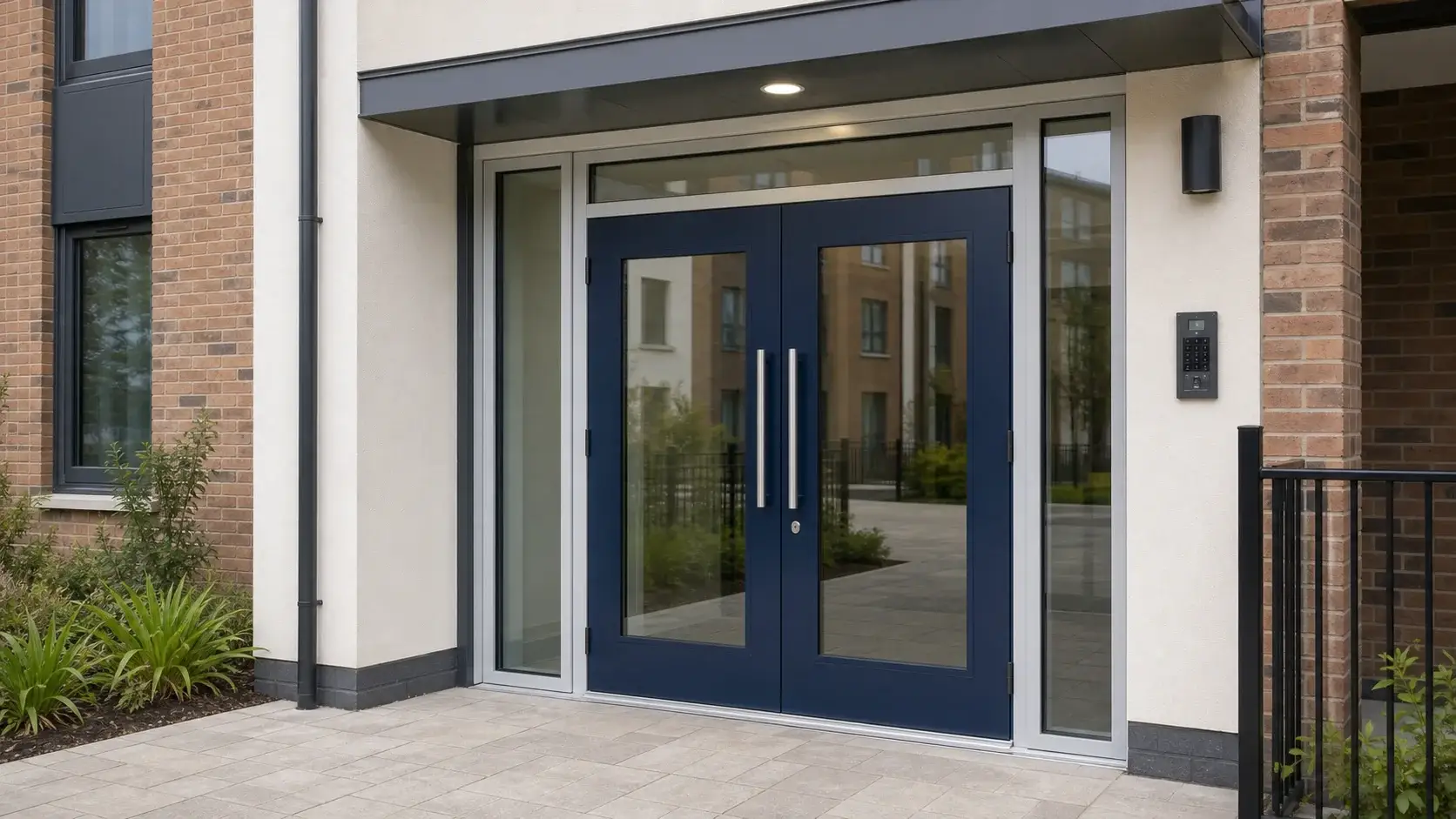
Two acronyms come up on almost every commercial aluminium door enquiry we get: PAS 24 and Part L. They both matter, they’re frequently confused, and on a tight programme it’s easy to assume one covers the other. It doesn’t. PAS 24 covers security. Part L covers thermal performance. Different tests, different evidence, different reasons your specifier asked for them.
This post is a quick orientation for installers and contractors so that when a fabricator quotes “PAS 24 capable” or “Part L compliant”, you know what’s in the box — and what to push back on if the quote is silent.
What each one actually is
PAS 24 is the UK security standard for doorsets and windows. It’s the standard you’ll see referenced when an end-client wants Secured by Design (SBD) accreditation, or when the building regulations Approved Document Q (security in dwellings) applies — which is most new-build residential and a good chunk of light-commercial work too.
Approved Document L is the building regulations document covering the conservation of fuel and power. It sets U-value targets — how much heat the door, window or façade is allowed to leak. The most current edition for England (Volume 1: dwellings, Volume 2: buildings other than dwellings) was significantly tightened in 2022 and again with the 2025 transition, and the targets get tougher every uplift.
A door can be PAS 24 tested but have a poor U-value. A door can have a great U-value but no PAS 24 test certificate. The two tests are independent. When you specify both, you need confirmation in writing that the doorset on order has been tested to both — not just that the system is “capable” of it.
When you need each one
The short answer: you nearly always need Part L compliance on any external door or window in a heated building. PAS 24 depends on the building type and the specifier’s brief.
| Application | PAS 24 likely required? | Part L always required? |
|---|---|---|
| New-build dwelling external door | Yes (Doc Q) | Yes |
| Refurbishment to a heated commercial unit | Sometimes (specifier-led) | Yes |
| Office entrance, public-facing | Often (insurance, SBD, specifier) | Yes |
| Internal door or screen | Rarely | No (internals exempt from L) |
| Plant room door (heated space boundary) | Rarely | Yes |
| Heritage / conservation conversion | Sometimes | Yes (with derogations available) |
If you’re unsure, the specifier or building control submission package is the source of truth. Don’t guess on a high-value job.
What the fabricator actually delivers
PAS 24 is a system test. The frame profiles, glazing, hardware combination, threshold, hinges and locking are all part of the certified assembly. You can’t substitute one component and keep the certificate — change the cylinder type, swap the hinges, fit a different glass build-up, and the PAS 24 evidence may no longer cover what’s installed.
What this means in practice when you’re ordering:
- Ask the fabricator for the test certificate reference (the body that issued it, the test specimen size, the hardware schedule).
- Confirm whether the doorset you’re being quoted is “tested to PAS 24” (specific evidence on file) or “PAS 24 capable” (system has passed elsewhere with a configuration similar to yours).
- For SBD jobs, the SBD compliance certificate is a separate document — it incorporates PAS 24 plus additional hardware/installation conditions. Get the SBD certificate, not just the PAS 24 reference.
For Part L, the U-value is a calculated value for the doorset as a whole, not just the centre-of-glass figure. A 1.0 W/m²K centre-of-glass figure is meaningless for compliance — you need the whole-doorset U-value. Frame depth, threshold, glazing build-up and any thermal break detail all factor in.
Reputable fabricators will quote a whole-doorset U-value (e.g. “1.5 W/m²K with 0.7 Ug”) so you can compare like-for-like. If a quote only gives Ug (centre-of-glass) without Uf (frame) or Uw (whole window), something’s missing.
What we typically supply
Our two main door systems on PAS 24 / Part L jobs:
- RD70 TruEnergy entrance doors — fabricated from PAS 24:2022 certified profiles, U-value 1.5 W/m²K (with 0.7 Ug glass) or 1.7 W/m²K (with 1.0 Ug). Multi-point locking standard, Secured by Design approved when specified with SBD-compliant hardware. Maximum tested 1100 × 2500 single, 1800 × 2500 double.
- TD68 commercial entrance doors — STS202 BR2 / PAS 24 tested, U-value from 1.7 W/m²K, 250kg pivot capacity. Tested to 1300 × 3000.
The numbers above come straight off the test evidence. Where your scheme deviates (different glass, non-standard cylinder, larger leaf than tested), we’ll flag the deviation and where possible quote a separate test reference that does cover it.
Quick checklist before placing an order
- Have you confirmed which standards the specifier is asking for — PAS 24, SBD, Doc Q, Doc L?
- Have you got the U-value target in writing (not just “Part L compliant”)?
- Are the glass spec and the hardware spec on the order matched to the test certificate? (Substitutions break certification.)
- Are side-light and fan-light arrangements covered by the same test, or do they need separate evidence?
- For SBD: is the installation method specified (frame fixings, packers, threshold seal) part of the SBD compliance package, and does your engineer or installer know it?
If you can answer those five clearly, the doorset arriving on site will fit the brief and pass building control. If you can’t, push the question back to the specifier or to us before committing — corrections after fabrication are slow and expensive.
Where we sit on it
We fabricate PAS 24 and Part L compliant aluminium entrance doors as a regular part of the trade range, and we’ll send the test references and U-value documentation with the quote on request. If the spec is ambiguous, we’d rather have a five-minute call about the brief than fabricate something that doesn’t pass inspection on site. Send the spec, the glass build-up and the hardware schedule when you quote — that’s enough for us to confirm whether what we’re about to make hits both standards.
If you’re working a job where compliance is the whole point — student accommodation, build-to-rent, school, healthcare, listed-building reuse — and you want a sanity check on the spec before you put it out for quote, drop us a line. No charge, no obligation, just an extra pair of eyes from someone who fabricates these doors every day.