
Product Spec
Aluminium Curtain Walling: Build-Up, Sightlines, and Spec for Commercial Contractors
Practical guide to specifying aluminium curtain walling on commercial schemes — sightlines, glazing build-up, wind load, fire requirements, and what to ask the fabricator before tender.
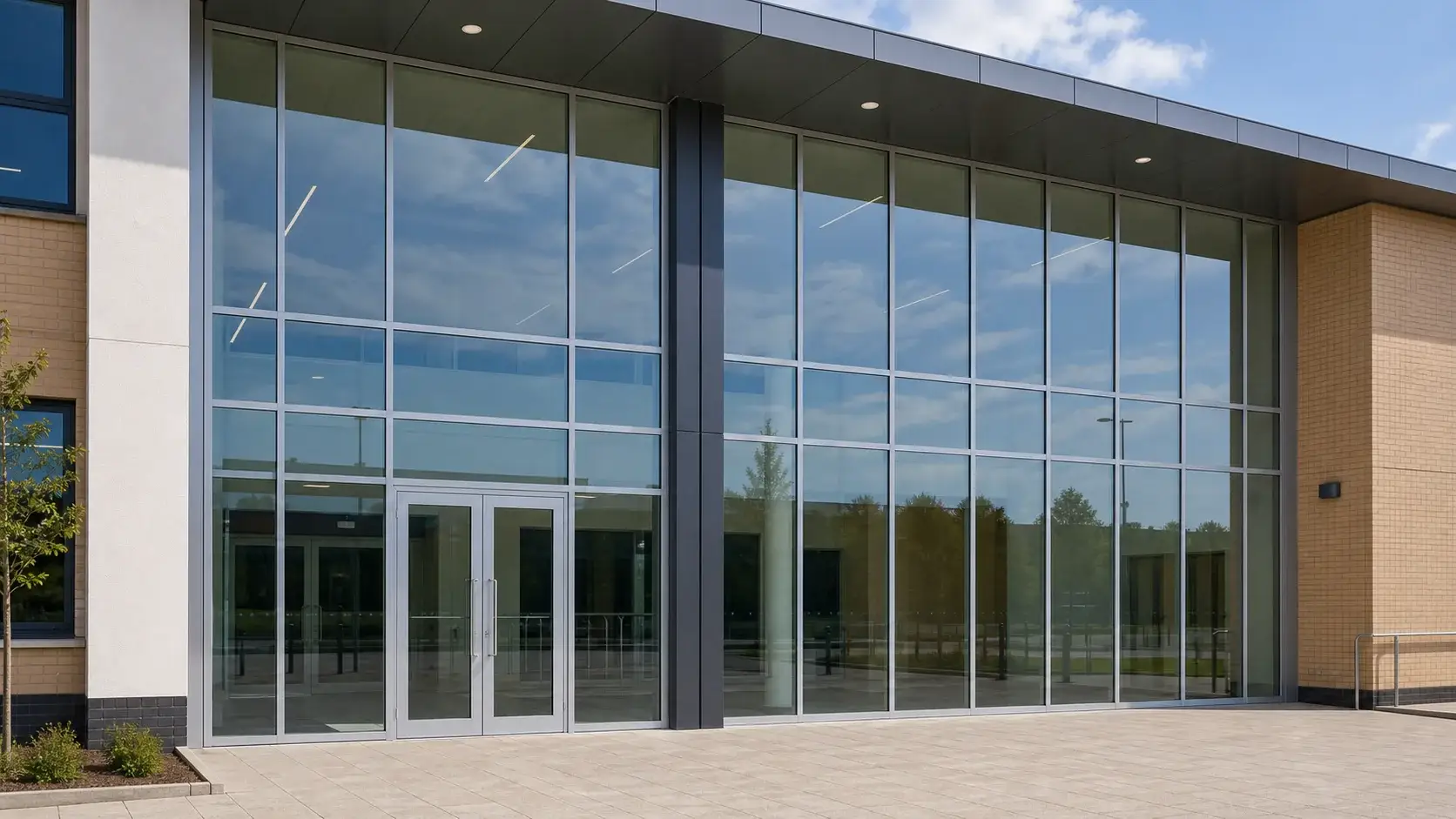
Curtain walling is the most spec-heavy product we fabricate. On a commercial entrance lobby it might be a few square metres. On a commercial tower facade it’s thousands. The detail level on the order is what makes the difference between a smooth fit-out programme and a procurement headache that delays the wider build.
This is the practical orientation we’d share with a commercial contractor sending us a curtain walling enquiry for the first time.
What curtain walling is and isn’t
Curtain walling is a non-load-bearing aluminium frame system, typically glazed, that hangs off the building structure to form the external envelope. It carries its own dead load and the wind load applied to the glazed panels, but doesn’t take any of the building’s structural load.
What it is not:
- Window walling is structurally similar but typically infill between floor slabs, not floor-to-floor continuous. Less complex to design, often used in residential and some commercial schemes.
- Glazed shopfronts are smaller-scale, ground-floor systems with retail-grade structural assumptions. The same aluminium fabricator typically supplies both, but the engineering differs.
- Rain screen cladding is an opaque external skin, not a glazed envelope.
If your specification document uses these terms interchangeably, push back at the architect or specifier. The wrong product on the order is a slow correction later.
The system spec questions
For our JCW curtain walling system, here’s what we need answered to quote properly. (If you want to understand what actually moves the price before you ask, see our guide to what drives curtain walling cost.)
1. Sightlines and module
- Mullion / transom sightline — JCW runs at 50mm sightlines as standard. Slimmer profiles are available on some systems but at a structural and price premium.
- Module width — what is the spacing between vertical mullions? Typical commercial offices specify 1500mm or thereabouts; retail and hospitality vary widely.
- Floor-to-floor module — does the curtain walling run continuous past slabs (with floor-line transom) or terminate and restart at each level?
2. Glazing build-up
- Total IGU thickness — most commercial work runs 28mm or 32mm units now. Higher-performance schemes go to 36-44mm with triple glazing.
- Glass spec per pane — toughened, laminated, low-iron, low-E coating, solar-control, fire-rated where applicable.
- Spandrel zones — opaque areas between floors, typically backed with a back-pan and insulation. These need to be specified separately from vision zones.
- Edge tape and warm-edge spacer — affects the whole-system U-value and the visual at the edge of glass.
3. Wind load and structural
- Design wind pressure — what’s the structural engineer specifying? JCW is tested to 2400 Pa as standard, which covers most UK low-to-mid-rise commercial up to 13m. Higher towers or exposed sites need higher pressure capability and may require a different system.
- Building movement — what live load deflection is the structural design allowing? The curtain wall fixing detail must accommodate it without cracking glass or breaking weather seals.
- Fixing back to structure — concrete slab, steel frame, masonry parapet, hybrid? The fixing detail varies and the contractor’s interfaces team usually owns this with the structural engineer.
4. Thermal performance
- Whole-system U-value target — Part L compliance hinges on the whole-system value, not the centre-of-glass figure. With a thermally broken JCW frame and 28mm low-E IGU, expect 1.4-1.6 W/m²K depending on detail.
- Thermal bridging at slab edges — the floor-line transom is a thermal weak point. Specify whether spandrel insulation, edge-of-slab fire-stopping and the transom build-up is documented as part of the curtain wall package.
5. Fire compartmentation
- Cavity barriers — at every compartment line behind a curtain wall, a cavity barrier is required to prevent fire spread. This usually sits in the spandrel zone but is sometimes specified separately.
- Fire-rated glass — required at compartment lines or where the curtain wall passes through a fire-rated opening. Different glass spec, different cost, longer lead time on order.
- Spandrel build-up — Class A2 non-combustible insulation is now standard on most commercial schemes following Approved Document B updates.
6. Operable elements
- Insert windows and doors — are there opening windows, accessible vents or door sets sitting within the curtain walling? Each insert is a different system tie-in and needs to be drawn at design-development stage, not added during fabrication.
- Smoke vents — automatic opening vents (AOVs) for stair pressurisation or smoke clearance need a clear interface with the curtain wall fabricator.
7. Performance testing
- CWCT-tested system — for any commercial work, the curtain wall system should have CWCT (Centre for Window and Cladding Technology) test data on file. JCW is CWCT tested.
- Project-specific testing — high-rise and bespoke schemes sometimes require project-specific mock-up testing. This isn’t standard but it’s worth asking the specifier whether it’s required so it can be programmed.
What we supply
Our JCW curtain walling system is the Jack Aluminium platform we fabricate at Warrington:
- 50mm sightline
- Tested to 2400 Pa wind load
- Up to 13m system height
- Compatible with JD47 shopfront door tie-ins, TD68 commercial door tie-ins, and SW60/TW70 window inserts
- Single or dual-colour PPC finish across the full RAL range
- CWCT tested
We fabricate the curtain wall as discrete frame sections and check the supplied order against the approved information before dispatch. Your facade installer or subcontractor installs on site; Kingsland does not install.
Programme reality
Allow approximately 21 working days for general planning. The quotation confirms the current lead time, its start point, the exact date and any exceptions caused by grid size, glass, opening vents, interfaces or drawing approval. Build that quoted timing into the procurement programme rather than applying an unconfirmed duration to the elevation.
Incomplete shop drawings at sign-off can delay a curtain-wall order. Confirm the modules, interfaces, glass and opening vents before the fabrication date is agreed.
How to engage us
Send the architectural elevations, the structural design loads, the IGU specification and the building’s compartment-line diagram. We will review the scope, ask any clarifying questions and prepare a quotation. We work supply-only for trade contractors and main contractors, as well as facilities, property and project teams buying for commercial schemes. Where a client-side team buys direct, its appointed facade contractor or subcontractor installs.
If you want us to review whether the supplied information is sufficient for a fabrication quotation, send the elevations and specification. Fire compartmentation, AOV interfaces, slab-edge thermal bridging and other design responsibilities must remain with the suitably qualified project team.