
Product Spec
Commercial Entrance Door Spec for High-Traffic Retail and Public Buildings
Specifying a heavy-duty commercial aluminium entrance door — frame depth, security rating, hardware, automation, and accessibility. Written for installers and main contractors on retail, schools, healthcare and public-building schemes.
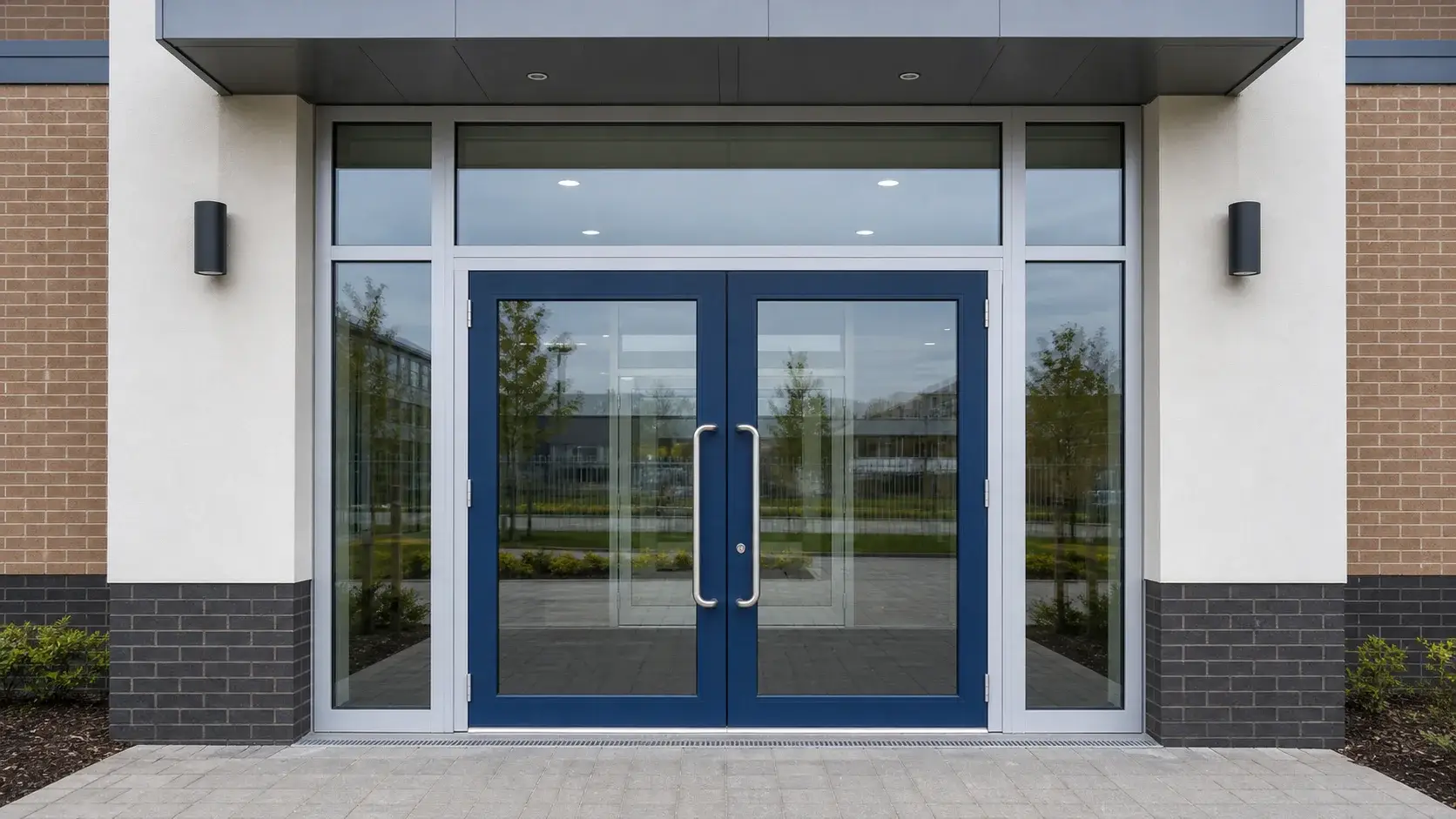
A high-traffic commercial entrance needs its duty, operating hours and expected cycle rate established for the actual building. Retail, education and healthcare entrances place different demands on hardware, leaf construction, thresholds and automation, so those items should be specified against the project brief and the relevant manufacturer ratings rather than a generic traffic assumption.
This post is the practical spec orientation for installers and main contractors specifying heavy-duty commercial entrance doors on retail, education, healthcare and public-building schemes.
The system spec basics
For our TD68 commercial entrance door, the headline numbers:
- Frame depth: 68mm thermally broken
- U-value: from 1.7 W/m²K with low-threshold detail
- Maximum tested: 1300mm wide × 3000mm tall
- Pivot capacity: 250kg
- Glazing: 24mm to 44mm sealed units
- Security: STS202 BR2, PAS 24, Secured by Design when specified with approved hardware
That’s the platform. The spec layer above the platform is where most schemes diverge.
The leaf — what high-traffic actually demands
A residential entrance leaf and a commercial entrance leaf look similar from a distance but are engineered very differently for working life.
Hinge or pivot? Heavy commercial leaves typically run on bottom pivots and floor springs (concealed in the threshold) rather than butt hinges. Pivots distribute load through the structure rather than the frame itself, which is what allows the 250kg leaf capacity. Specify the pivot rating against the leaf weight, not the leaf size — a heavily-glazed leaf is heavier than its dimensions suggest.
Closer mechanism. A floor spring hides the mechanism at threshold level. A surface-mounted overhead closer remains visible and is generally easier to access for replacement, while a concealed-in-transom closer keeps the mechanism in the head. Select the closer from the verified leaf weight, opening angle, accessibility duty, environment and manufacturer cycle rating.
Hardware schedule. For high-traffic public-facing doors, expect a brief that includes:
- Multi-point or motorised lock with TOTAL/LIGHT/FREE access modes (configurable lock states for time-of-day operation)
- Anti-snap cylinder
- Concealed panic bar or surface-mounted panic hardware
- Curved finger guard (anti-finger trap)
- Kick plate at the bottom
The TD68 platform supports all of those with the appropriate test certification — but the certification is per-configuration. If your scheme deviates from the tested hardware schedule, the certification needs revalidating or the spec adjusting.
Automation — the operator question
Most high-traffic commercial entrances now run on automation, either swing or sliding.
Swing operators (low-energy or full-power) sit above the door and motorise the closer. Common brands: Dorma ED100/ED250, Record DFA127, Geze Slimdrive EMD. The TD68 platform is fabrication-prepared for swing-operator integration; the operator is fitted by the door automation specialist on site.
Sliding operators move the entrance leaves along a track above the opening. The particular leaf arrangement, head detail and frame interface depend on the named operator and specialist entrance specification. For sliding entrances, our automatic sliding door frames are assessed from that complete brief and supplied ready for the appointed automation specialist to fit and commission the operator.
Before ordering the door, confirm:
- Brand and model of the operator (or the spec range — operator brand sometimes finalises late on commercial schemes)
- Whether the operator is fitted in the head detail (standard) or in a separate transom housing
- Power supply and control wiring routing — usually a separate trade but the door fabricator needs to know about service penetrations
- Whether breakout swing is required (sliding doors that can fold to swing for emergency egress)
An unresolved operator interface can cause late-stage door rework. Confirm it at design stage.
Accessibility (Approved Document M)
Approved Document M (Volume 2 for non-dwellings) sets the accessibility standards for commercial entrance doors. Headline points:
- Threshold height — typically 15mm maximum upstand for accessible entrances
- Opening force — 30N maximum to begin opening, 22.5N to keep the door open
- Clear opening width — 800mm minimum for principal entrance accessibility
- Vision panel position — accommodating both standing and seated users (typical glazed area between 500mm and 1500mm above floor)
The TD68 supports thermally broken low-threshold detailing that meets Doc M requirements when specified appropriately. If the entrance is the principal accessible entry to a building, document the threshold detail and the opening force on the order so the fabricator can confirm fit.
Security — when the public-building risk profile matters
Commercial entrance security spec depends heavily on the building type:
Retail (high street, shopping centre). PAS 24 is common; SBD is sometimes specified by insurers; STS202 BR2 is appropriate for higher-risk units (jewellery, pharmacy, financial services). Out-of-hours roller shutters integrate with the door frame; specify whether the shutter housing is part of the door order or a separate package.
Education (schools, colleges). PAS 24 plus controlled access (electronic strikes, magnetic locks integrated with the school’s access control system) is standard. Anti-finger-trap detail is mandatory in primary education. Concealed panic hardware on emergency exits.
Healthcare (NHS estates, primary care). PAS 24 plus extended cycle testing. Anti-microbial finishes are sometimes specified on hardware. Smoke-stop detail at the door is critical where the entrance crosses a fire compartment line.
Public buildings (council, library, civic). PAS 24 plus accessibility (Doc M) is the baseline. SBD is often a specifier preference rather than a regulation requirement.
For all of the above, the hardware schedule on the order needs to be confirmed against the test certificate evidence. PAS 24 is a system test — substitute the cylinder and the certification may not cover the substitute.
Glazing — the leaf composition
Most commercial entrance doors are partially or fully glazed. The glazing build-up affects security, thermal, acoustic and safety performance:
- Thickness range for TD68: 24mm to 44mm sealed units
- Toughened (Class 1) safety glass is the minimum for commercial entrance doors per Approved Document N
- Laminated glass adds bandit-resistance and acoustic performance — common on retail and public buildings
- Low-iron glass for clarity (gallery / showroom applications)
- Solar-control coating for south-facing entrances with heavy summer gain
- Acoustic interlayer for entrances facing busy roads or rail corridors
Specify the glass build-up per leaf, not just for the doorset overall. Side-lights and fan-lights may have a different spec.
The interfaces — how the door fits the building
Last category, often the most fraught. The commercial entrance door interfaces with:
- The structural opening — concrete head, steel beam, or masonry — the fixing detail differs
- The threshold floor finish — terrazzo, polished concrete, tile, entrance matwell — and whether the matwell extends across the threshold line
- The shopfront or curtain wall — if the entrance sits within a JCW or JD47 frontage, the head and jamb tie-in profiles need to match
- The internal lobby — automatic doors create a draught lobby; specify whether the inner door is part of the same order
- Services penetrations — automation power, access control wiring, smoke detector inputs (where the door interacts with the fire alarm)
Document the interfaces on the survey. The fabricator can quote the door, but the interfaces are a coordination issue across multiple trades.
How we work it
Send the architectural elevation, the hardware schedule, the operator brand (or specification range), and the threshold and accessibility requirements. We will review the certification path against the test evidence and prepare a quotation, with CAD shop drawings for sign-off where required before fabrication.
For high-traffic commercial schemes — retail flagship, school principal entrance, healthcare main lobby, public building accessibility — getting this right at order stage is the difference between a smooth fit-out and a series of late-stage variations. We’d rather spend 30 minutes on a video call walking through your spec than build a door that doesn’t fit the brief.
If you’re spec-ing a high-traffic commercial entrance and want a sanity-check on the spec before tender, drop us a line.